Best Books on Investment Fees and MER for Canadian TFSA and RRSP Investors: The $103,000 Fee Gap in 5 Reads
Most Canadian investors have never looked up the MER on their funds. That number, buried on page 1 of a Fund Facts document, quietly compounds against a portfolio every year. Five books explain why the gap between a 0.4% MER and a 2.0% MER amounts to roughly $103,000 over 30 years on the same monthly contributions. This reading list covers the foundational math, the Canadian-specific fee mechanics, and the psychology behind why most people never check. No advisor, no finance degree, and under 10 hours of reading to get through all five.
For educational purposes only. Not financial advice. ETF and MER examples are illustrative; comparable products from other providers exist.
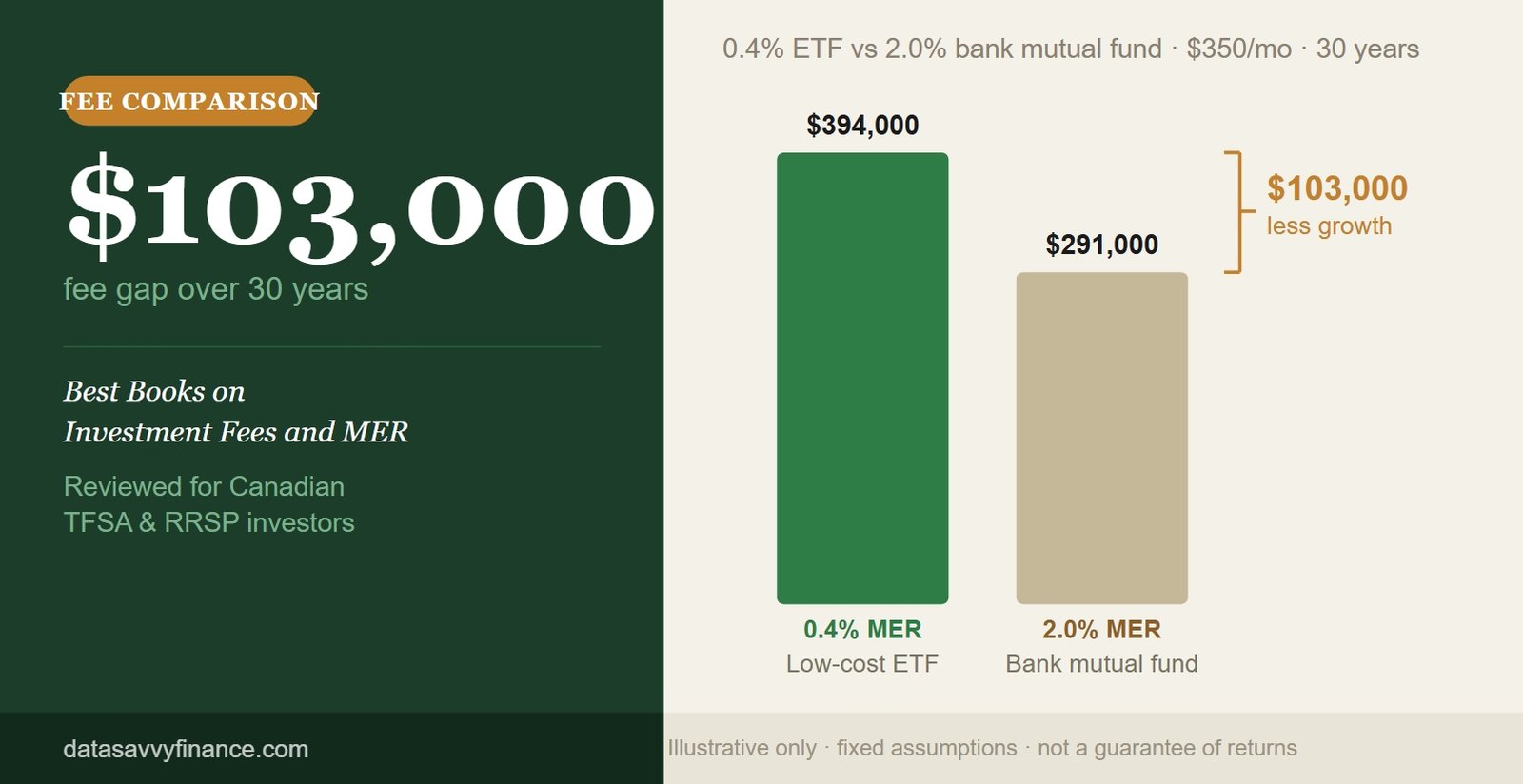
A few years ago I sat down and actually did the math on a fund I’d been holding for a while, and it kind of ruined my afternoon. Here’s the illustrative version of what I found. Say you contribute $350 a month for 30 years and earn an average 7% return before fees. At a 0.4% MER, which is in the range of a lot of low cost Canadian ETFs, you’d land somewhere around $394,000. At a 2.0% MER, which is still pretty normal for a bank branch mutual fund in Canada, that same contribution pattern lands closer to $291,000. That’s a gap of roughly $103,000, and again, the only variable that changed was the fee. This is an illustrative example with fixed assumptions, not a forecast, but it’s the kind of number that makes you go check your own statements.
That gap is also the entire reason this reading list exists. Fees are the one part of investing you fully control. You can’t control market returns, but you can absolutely control what you pay to access them, and a handful of books explain this better than most financial advisors ever will.
Why Fees Deserve Their Own Reading List
Most personal finance content treats fees as a footnote, a line buried somewhere in a fund fact sheet that nobody actually reads. That’s a mistake, because fees are honestly the most predictable variable in the entire investing equation. Market returns bounce around every year. Fees almost never do. A 2% MER is a 2% MER whether the market is up 20% or down 20%, and that consistency is exactly why it compounds into such a large number over time.
I used to think a percentage point or two in fees was basically rounding error. It is not. Run the math on a $500,000 portfolio over 25 years and the difference between a 0.25% MER and a 2% MER isn’t a rounding error, it’s often six figures. Most people never run that math because nobody hands them the calculator. That’s really the gap these books fill.
If you want to see this with your own numbers instead of my illustrative example, the investment growth calculator lets you input your actual contribution amount, fee difference, and timeline so you can see how fees impact your portfolio directly.
What makes a book worth including on this specific list isn’t just that it mentions fees in passing. It’s that the book treats fee awareness as a central skill, something you actively practice rather than something you vaguely know about. The five books below earned their spot because each one tackles a different angle of the fee problem, whether that’s the raw math, the Canadian specific fee landscape, or the psychology of why we tend to ignore costs that don’t feel painful in the moment.
The Foundational Fee Book
If you only read one book on this entire list, it should probably be The Little Book of Common Sense Investing by John Bogle. I’ve written a full review of it separately, since it deserves more than a paragraph, but the short version is this. Bogle makes the cleanest possible argument that costs are the single most controllable factor in your long term investing outcome, and he backs it with decades of fund performance data.
What I’ll add here that I didn’t fully cover in the dedicated review is how this book functions as the entry point for everything else on this list. Once you internalize Bogle’s core formula, gross return minus costs equals what you keep, the rest of the books here start making a lot more sense, because they’re really just applying that same lesson to different specific situations. If you haven’t read it yet, the full review walks through exactly how the math applies to Canadian TFSAs and RRSPs.
View on Amazon Canada →The Little Book of Common Sense Investing, John C. Bogle
Books That Break Down Canadian Mutual Fund Fee Structures
This is where things get specifically Canadian, and honestly where most general finance books fall short. Enough Bull by David Trahair is the book I’d point to first here. Trahair is a Canadian chartered accountant, and the book spends real time on how Canadian mutual fund fees work, including trailer fees and the way bank branch funds are structured to compensate advisors through ongoing commissions baked into the MER rather than an upfront charge you’d actually notice.
View on Amazon Canada → Enough Bull, Trahair Bull, Trahairn
What I appreciated about this one is that it doesn’t just say fees are bad. It explains the actual mechanism, how a portion of that MER you’re paying every year gets paid out to whoever sold you the fund, year after year, regardless of how the fund performs. Once you understand that mechanism, a 2% MER stops looking like an abstract number and starts looking like an ongoing payment to someone else, which it kind of is.
The book is also useful for understanding DSC funds, deferred sales charge structures that used to be common in Canada and came with their own penalty fees for selling early. Regulatory changes have phased a lot of this out, but if you or a family member is still holding an older fund, understanding how these structures worked can explain some confusing account statements.
For a side-by-side comparison of what a typical Canadian ETF charges versus a typical bank mutual fund, the MER impact article lays out several real world style scenarios with the dollar math spelled out.
Books on the Psychology of Fee-Blindness
Here’s something I didn’t expect to learn from a personal finance book, but The Psychology of Money by Morgan Housel has a few chapters that explain fee blindness better than most books that are actually about fees. Housel’s broader point is that financial decisions are driven by emotion and habit way more than by spreadsheets, and fee blindness is a perfect example. A 2% annual fee doesn’t feel like anything in the moment. There’s no single bill, no painful withdrawal. It just quietly reduces your balance every single day in a way that’s basically invisible unless you go looking for it.
View on Amazon Canada →The Psychology of Money, Housel
Thinking Fast and Slow by Daniel Kahneman gets a mention here too, even though it’s not a finance book specifically. Kahneman’s research on cognitive biases explains why humans are bad at evaluating small, recurring costs compared to large, one time costs. We’re wired to notice a $500 surprise bill and basically ignore a 1.5% fee that costs us way more over time. Understanding that bias is genuinely useful, because it explains why fee awareness has to be a deliberate habit rather than something that comes naturally.
I’ll admit the Kahneman book is a heavier read than the others on this list, and you don’t need the whole thing to get the relevant insight. If you’re short on time, the chapters specifically on loss aversion and the difference between System 1 and System 2 thinking are the ones worth prioritizing for the fee blindness angle.
View on Amazon Canada →Thinking Fast and Slow, Kahneman
How to Use These Books With a Real Fee Calculator
Reading about fee drag is useful, but it stays abstract until you attach real numbers to your own situation. The most useful exercise this reading list sets up is comparing whatever MER is currently on a fund someone holds against the MER of a low cost Canadian ETF in the same general asset category. A current MER is usually findable on an account statement or a fund’s fact sheet. Low cost Canadian ETFs in broad market or asset allocation categories often sit somewhere between 0.05% and 0.25%.
Once you have both numbers, the investment growth calculator lets you plug in your actual contribution amount and timeline to see the real dollar gap, rather than relying on my illustrative $103,000 example or anyone else’s hypothetical numbers. This is the exercise every book on this list is ultimately pointing you toward, even if none of them hand you a calculator directly.
Conclusion
Five books, one underlying lesson. Fees are the most predictable, most controllable variable in your entire investing outcome, and the gap between a low fee and high fee portfolio is rarely small once you let it compound over a couple of decades. Bogle gives you the foundational math, Trahair gives you the Canadian specific mechanics, and Housel and Kahneman explain why most people never bother to check in the first place.
None of this requires an advisor, a course, or a finance degree. It requires a few hours of reading and a calculator.
The Little Book of Common Sense Investing by John Bogle is the clearest foundational source on this. For Canadian specific mutual fund fee mechanics, Enough Bull by David Trahair goes deeper into how trailer fees and Canadian fund structures work.
As an illustrative example using fixed assumptions, a 1.6% MER gap (0.4% vs 2.0%) on $350 monthly contributions over 30 years at 7% gross amounts to roughly $103,000 in reduced portfolio value. Use a calculator with your own numbers for an accurate picture of your specific situation.
Generally yes. Canadian bank branch mutual funds commonly carry MERs in the 1.5% to 2.5% range, while broad market Canadian ETFs often charge between 0.05% and 0.25%.
The Little Book of Common Sense Investing covers the foundational math most clearly. Enough Bull goes deeper into the Canadian specific fee mechanics and is most useful once the foundational concept of fee drag has already clicked from the Bogle book.