The Little Book of Common Sense Investing Review: The $47,000 Fee Lesson for Canadian TFSA and RRSP Investors
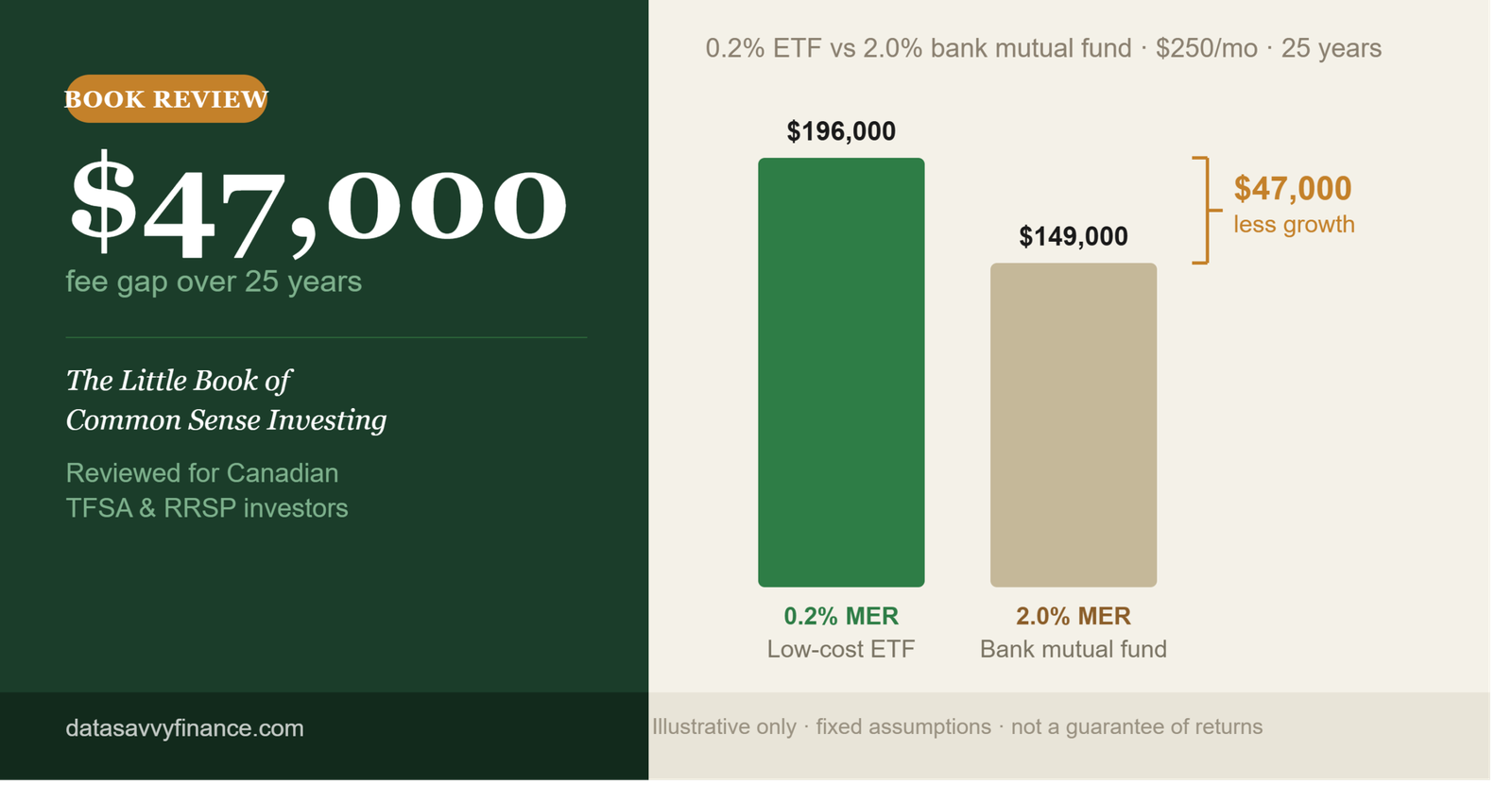
John Bogle spent 200 pages making one argument: costs matter more than almost anything else in investing, and most of the financial industry is built around keeping you from noticing that. For a Canadian TFSA or RRSP holder, that argument has a specific dollar figure attached. At 0.2% vs 2.0% MER, $250 a month over 25 years produces a portfolio gap of roughly $47,000. This review covers what the book gets right, which chapters are worth reading twice, and where Canadian investors need to translate the American examples into their own account context. No advisor required.
For educational purposes only. Not financial advice. ETF examples are illustrative; comparable products from other providers exist.
I read this book on a Sunday afternoon a few years back, expecting another dry finance lecture. Instead I closed it feeling kind of annoyed, in a good way. Annoyed because the math in here is so simple that it makes you wonder why more people don’t talk about it. John Bogle, the guy who founded Vanguard and basically invented the index fund as something regular people could buy, spends about 200 pages making one argument over and over: costs matter more than almost anything else in investing, and most of the financial industry is built to keep you from noticing that.
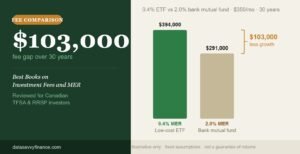
Here’s an example to show why this matters in dollar terms. Say you invest $250 a month for 25 years, with no initial lump sum, and earn an average 7% return before fees, compounded monthly. At a 0.2% management expense ratio, which is roughly what a low cost Canadian ETF charges, you’d end up with somewhere around $196,000. At a 2.0% MER, which is still common in Canadian bank mutual funds, that same contribution pattern lands closer to $149,000. That’s a gap of about $47,000, and the only thing that changed was the fee. This is an illustrative example using fixed assumptions, not a guarantee of future returns, but it’s the kind of number that sticks with you. John Bogle spends about 200 pages making one argument over and over: costs matter more than almost anything else in investing. The Little Book of Common Sense Investing, John C. Bogle Sense Investing is available on Amazon.
If you want to plug in your own contribution amount and timeline instead of taking my numbers at face value, the investment growth calculator lets you see how fees impact your portfolio using your actual situation.
What This Book Actually Argues
Bogle’s whole case rests on one idea that sounds almost too obvious once you hear it. Markets, taken as a whole, deliver a certain return. Every dollar an investor pays in fees, trading costs, or taxes is a dollar subtracted from that return. Since the market return is finite and shared among everyone in it, the only way to reliably get more of it for yourself is to take less out in costs. You can’t out-trade or out-guess the market consistently enough to make up the difference, but you can absolutely control what you pay.
This is where the book gets specific in a way I didn’t expect. Bogle walks through decades of fund performance data showing that the average actively managed fund underperforms its benchmark index after fees, and that this isn’t a fluke of one bad decade. It shows up again and again across different time periods. He’s not saying every active manager is bad at their job. He’s saying the fee drag is large enough that even skilled managers usually can’t overcome it for their investors over the long run.
What struck me reading it the second time was how unemotional the argument is. There’s no fear mongering about market crashes or hype about beating the market. It is just math, presented clearly, with the data laid out so you can check it yourself. The book’s central formula is almost embarrassingly simple: gross return minus costs equals net return. Everything else in the book is really just supporting evidence for that one line.
One thing worth flagging if you’re newer to this. The book uses American examples throughout, since Bogle built his career around US index funds and the S&P 500. The numbers and fund names won’t map directly onto Canadian products, but the underlying math about fees and compounding works exactly the same regardless of which country you’re investing in.
Does Bogle’s Argument Hold Up for Canadian Investors?
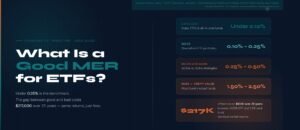
Short answer, yes, and honestly the Canadian fee environment makes the book’s argument hit even harder. Canada has historically had some of the highest average mutual fund fees among developed countries, with bank branch mutual funds commonly charging MERs in the 1.5% to 2.5% range. Compare that to a broad market Canadian ETF, which often charges somewhere between 0.05% and 0.25%, and you’re looking at a fee gap that’s larger than what Bogle was even describing in the American context when he originally wrote this.
The mechanics translate directly. A TFSA or RRSP holding a high fee mutual fund is subject to the exact same fee drag math as a US 401k holding an expensive actively managed fund. The account type doesn’t change the arithmetic. What changes is the tax treatment, and that’s actually a place where Canadian investors get something extra to think about that Bogle’s book doesn’t cover, since TFSAs and RRSPs work differently from the American retirement account structures he references.
If you want the deeper dive into exactly how MER differences compound over time with real Canadian numbers, the full MER impact article walks through several scenarios side by side. This book gives you the why. That article gives you the Canadian specific how.
I’ll be honest, the first time I read the chapter on fee drag, I went and checked the MER on an old mutual fund I used to hold and felt a little sick. It wasn’t egregious, around 2.1%, but seeing the dollar impact laid out over a 20 year horizon was a wake up call. That’s really what this book is good for. It’s less about teaching you something totally new and more about making a fact you sort of already knew impossible to ignore anymore.
Key Chapters Worth Re-Reading
Not every chapter in this book carries equal weight, and if you’re short on time there are a few worth prioritizing. The chapter on the relentless rules of humble arithmetic is the one I’d point a Canadian reader to first. It’s where Bogle lays out the core costs argument most directly, with the clearest version of the gross return minus costs equation in the whole book.
The chapter comparing index fund performance against actively managed funds over 15 and 20 year periods is the second one I’d flag. It’s data heavy, but the pattern it shows, where the percentage of active funds beating their benchmark shrinks as the time horizon lengthens, is genuinely useful context for anyone trying to decide between a low cost ETF and a fund with a manager attached.
The chapter on simplicity as a strategy, rather than a compromise, is the one that’s aged the best in my opinion. Bogle wrote this before the explosion of all in one ETF products that Canadian investors have access to now, things like balanced asset allocation ETFs that hold global stocks and bonds in one ticker. His argument that complexity is usually a cost center rather than an advantage applies almost perfectly to why those simple, one fund portfolios have become so popular here.
What’s dated, in case you’re wondering, is some of the specific fund names and a handful of references to financial products that don’t really exist in their original form anymore. None of that undermines the core argument. The math doesn’t expire.
Who Should (and Shouldn’t) Read This Book
This book is the right starting point if you already have a basic grip on how investing works and you want the underlying logic for why low cost index investing makes sense, rather than just being told it does. If you’re newer to the basics and terms like expense ratio or compounding still feel shaky, you might get more out of starting with a beginner focused Canadian personal finance book first and circling back to this one once the fundamentals feel solid.
It’s probably not the right fit if you’re looking for a step by step Canadian implementation guide. This book builds the philosophical case extremely well, but it won’t walk you through opening a TFSA, choosing between specific Canadian ETFs, or understanding account contribution limits. For that, pairing it with our ETF asset allocation guide covers the practical Canadian side this book doesn’t touch. For a broader reading list that goes from conviction to Canadian implementation, Best Books for Canadian Passive Investors covers eight books in the order most readers find useful.
I’d also say it’s not the book to reach for if you’re in the middle of a market downturn and looking for reassurance. It’s a calm, data driven argument, not an emotional pep talk. For that kind of support, something focused more directly on investor psychology tends to land better in the moment.
How to Apply This Book’s Lessons in a TFSA or RRSP
Translating Bogle’s core argument into a Canadian context is a smaller leap than it sounds. Inside a TFSA or RRSP, the equivalent of what he describes is a fund that tracks a broad market index with a low MER, rather than a fund where a manager is actively selecting individual securities. That’s the practical translation of “gross return minus costs equals what you keep” in a Canadian account context.
Canadian ETF MERs for broad market or all in one diversified products commonly sit in the 0.05% to 0.25% range, which is the kind of cost level Bogle’s math says you want. Comparing that against whatever is currently being held, whether that’s a bank mutual fund or an advisor managed portfolio, is the single most useful exercise this book sets you up to do.
If you want to see what that comparison actually looks like with real numbers instead of a hypothetical, the investment growth calculator lets you input a contribution amount, timeline, and the fee difference you’re working with, so you can see the real dollar impact rather than taking anyone’s word for it, including mine.
Conclusion
What I keep coming back to with this book is that it doesn’t ask you to trust anyone. Bogle shows the data, walks through the math, and lets the numbers make the case. For a Canadian investor sitting on a high fee mutual fund inside a TFSA or RRSP, that math translates into a real, calculable dollar difference over time, and this book is one of the clearest places to understand exactly why that difference exists.
It’s a weekend read, no advisor or course required, and the core idea fits on a sticky note: gross return minus costs equals what you actually keep. The Little Book of Common Sense Investing, John C. Bogle is available on Amazon Canada.
Frequently Asked Questions
The book argues that since market returns are finite and shared among all investors, minimizing the costs you pay (fees, trading costs, taxes) is the most reliable way to keep more of your own return, since the market cannot be consistently outperformed through stock picking or fund manager selection.
Yes. While the book’s specific fund examples are American, the underlying math about fee drag and compounding applies the same way to Canadian TFSAs, RRSPs, and ETFs. Given that Canadian mutual fund fees have historically run higher than US averages, the book’s core argument arguably applies with even more force here.
Look for the most recently updated edition, since Bogle revised the book with newer performance data in later printings. The core argument hasn’t changed across editions, but the supporting data is more current in the newest version.
This book is strongest on the philosophical and mathematical case for low cost investing. It is not a Canadian implementation guide. Pairing it with Canadian-specific resources on TFSA and RRSP mechanics and Canadian ETF selection rounds out what it doesn’t cover.