In the Age of AI, What Is the Best Enrichment Class for Kids’ Critical Thinking?
For about a decade, coding was the safe answer. Buy your kid one future-proof skill, sign them up for a coding class, feel reasonably sure the money was well spent. Then the headlines turned: AI can write code now, so why teach a kid to do it.
Before you cancel the coding class, notice who is making that prediction. The loudest “nobody will need to code” claims come from the companies selling the tools meant to replace coding, which is not a neutral source. Weighing a claim against who benefits from you believing it is the real skill you are shopping for, more than any single subject. And coding still teaches real thinking. You cannot judge what a machine writes for you if you have never written a line yourself.
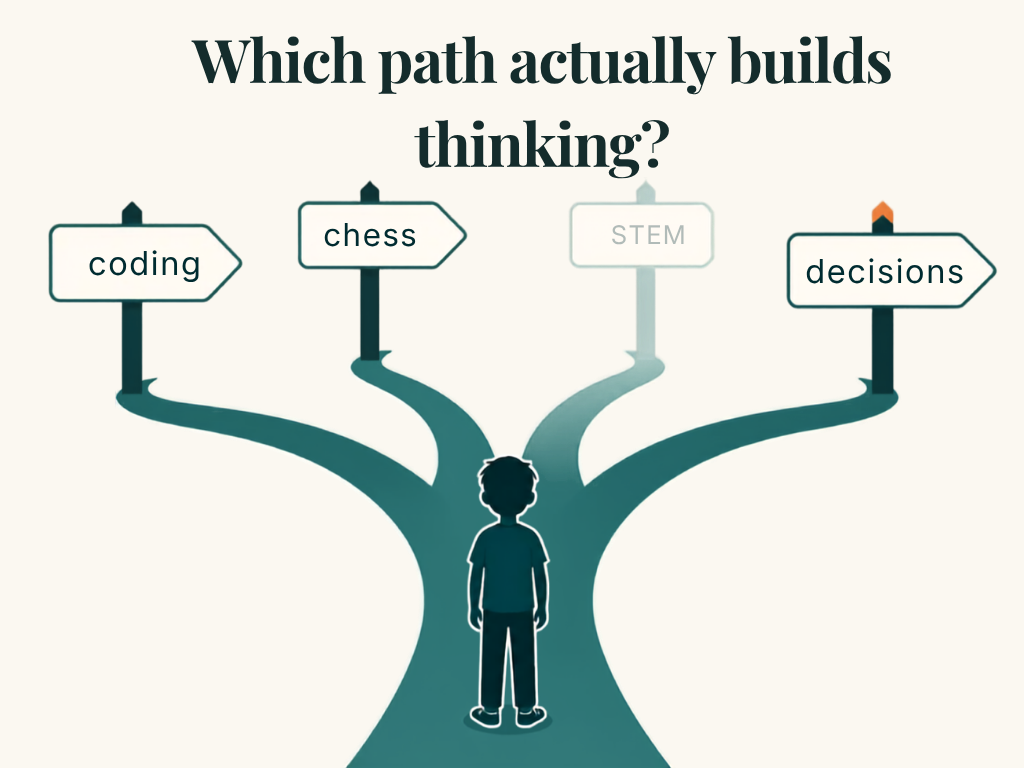
So the question was never whether to drop coding. It is which enrichment builds the part of thinking the tools do not replace, the noticing, the weighing, the deciding. That is usually what a parent means by critical thinking: not the subject, but the part underneath it.
This piece compares the usual picks, coding, chess, STEM, music, debate, against what each builds and where each quietly stops. We run a class in this space, which is exactly why we are not going to tell you ours is the best one. Best depends on what you want your kid to walk away able to do, and by the end you will have a clear enough map to decide that yourself.
This article is educational and reflects our own analysis and opinion. It is not financial, investment, or parenting advice, and it is not a recommendation to enroll in any specific program. Any dollar figures are illustrative, meant to show how the math works rather than to promise a result. Prices and program details vary by provider and change over time, so confirm current details yourself before deciding.
First, pin down what “critical thinking” actually means
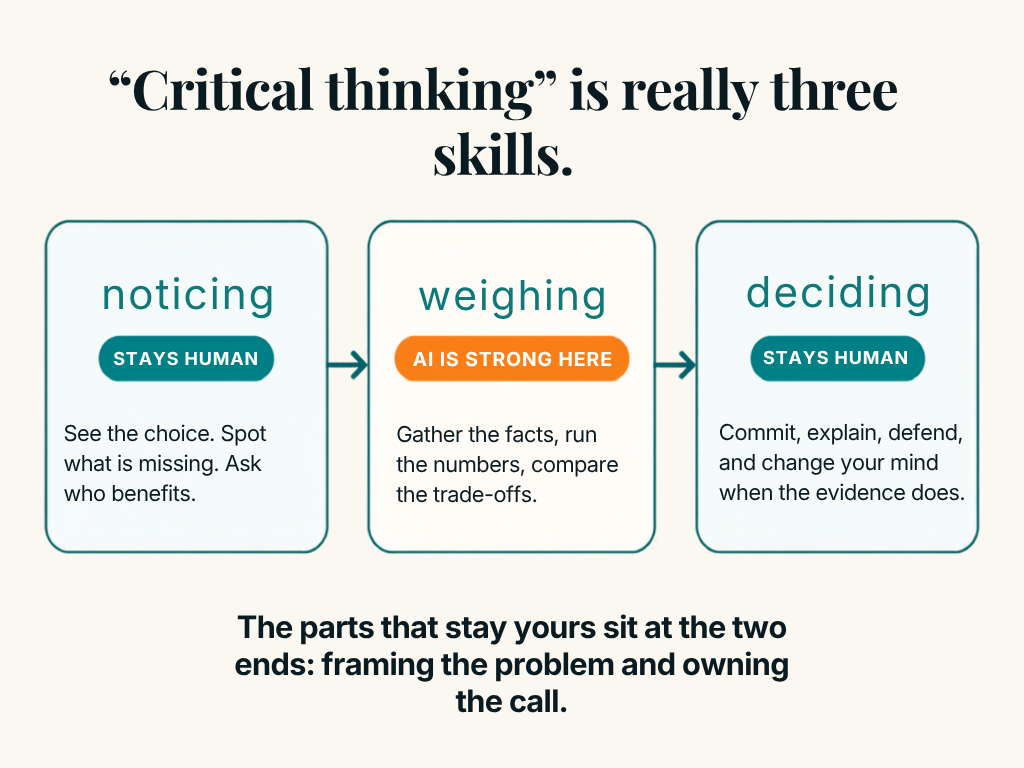
Critical thinking is one of those phrases that sounds specific and turns out not to be. Before you can compare enrichment programs on it, you need to know what you are comparing them on. It helps to break the phrase into three plainer skills, because most programs train one or two of them well and quietly leave the third alone.
The first is noticing. Seeing that there is a decision to make at all, working out what the decision actually is, and spotting what is missing or who benefits from a given answer. This is the skill the intro leaned on, realizing that “nobody will need to code” is being sold by the people with something to gain from you believing it. A kid who notices well asks the question before accepting the answer.
The second is weighing. Gathering the relevant facts, putting numbers to them, comparing the options honestly, and being clear about the trade-offs. This is the part that looks most like schoolwork, the estimating and calculating and comparing, and it is also the part a machine now does quickly and fluently.
The third is deciding. Committing to a choice, explaining why, defending it when someone pushes back, and changing your mind when the evidence changes. It includes the least comfortable move of all, catching when a confident answer is wrong, including your own, and including one a machine hands you in clean, assured prose.
This plain-language split is our own, but it lines up with how decision science and critical-thinking research carve up the same ground, from Herbert Simon’s intelligence, design, and choice, to the Delphi Report’s core skills of interpretation, analysis, evaluation, and inference.
Here is why the AI question keeps circling back to this. Machines are very good at the middle skill now. They will weigh, summarize, and argue on command. What they cannot do is the noticing, because they do not know what matters to your kid or your family, and they cannot do the deciding, because they do not live with the result. The parts that stay human sit at the two ends, framing the problem and owning the call.
So that is the yardstick. When you look at any enrichment option, coding, chess, a music program, ask which of the three skills it actually trains, and how much of it lands in the parts a machine will not do for your kid. That is the lens for the comparison that follows.
Before the table, one habit worth teaching
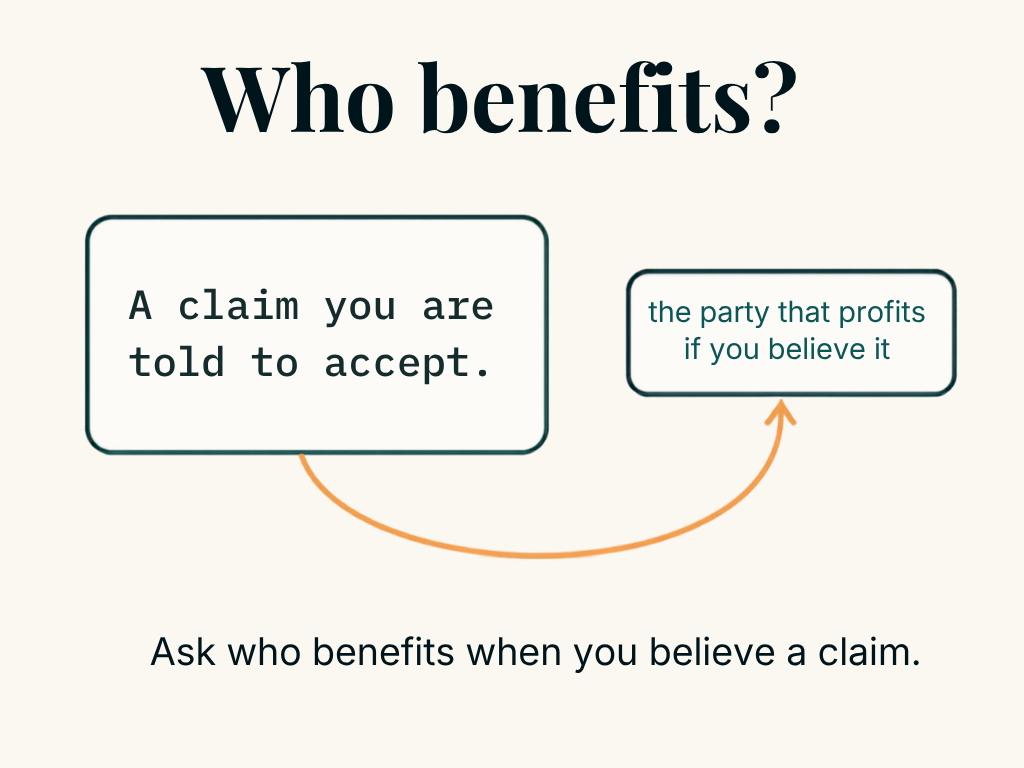
Notice who benefits when you believe a claim. That is the single most useful thinking habit in this whole piece, and it is worth teaching your kid directly, because it is the one that does not go out of date.
We run this check on ourselves as much as anyone. Here is one most adults meet too late. In Canada, the person selling you a mutual fund at your bank is usually not a fiduciary, someone legally bound to put your interests first. They work to a suitability standard, so a recommendation only has to be appropriate for you, not the best available. Reforms in 2021 raised that bar, telling them to put your interest first within the suitability test, but stopped short of a full fiduciary duty, which in Canada is generally reserved for portfolio managers. The advice is not a lie. It is shaped by who benefits, and seeing that shape is the whole skill.
The same lens sits over the enrichment aisle. “Kids will not need to code” is loudest from the companies selling the tools meant to replace coding. A coding school has a reason to tell you coding is essential. A chess program has a reason to tell you chess builds reasoning. And we have a reason to tell you that deciding well is the skill of the age. None of those claims is disqualified by the incentive behind it, but none earns a free pass either. That is why the table below rates each option on what it plainly builds, and why we are not going to end by naming a winner.
This is just the first skill from a moment ago, noticing, turned on the enrichment market itself. Read the comparison with it switched on, asking who is talking, what they gain, and whether the claim survives once you know.
What each enrichment actually builds
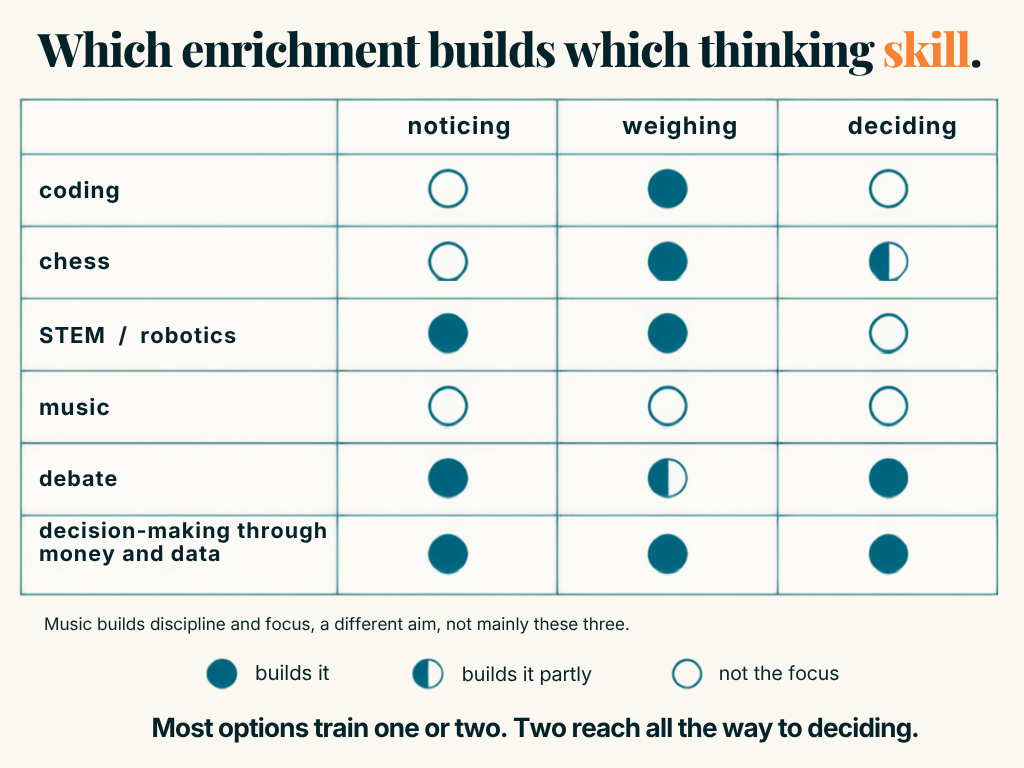
Here is the comparison, read through the three skills from earlier and the incentive lens from just now. Each option gets its real strengths, because a table that only flatters one option is not worth reading.
| Option | Mainly builds | What it does well | Where it quietly stops | Survives when a machine can do the task |
|---|---|---|---|---|
| Coding | Weighing | Logical sequencing, debugging, precise cause and effect; and you cannot judge AI-written code without having coded | Problem usually arrives already framed; rarely asks whether the goal is the right one | Partly. The doing is automating; judging what to build and whether it is right stays human, but only if the craft was learned |
| Chess | Weighing, some deciding | Planning ahead, pattern recognition, thinking through consequences, committing to a move | Closed rules, perfect information, no real stakes; the better-designed studies find little of it transfers beyond the board | The mental habit stays yours; the game itself was lost to machines long ago |
| STEM / robotics | Noticing, weighing | Test and measure, evidence over guessing, iterate toward a result | Often kit-guided toward one known right answer; less open trade-off weighing than it looks | The experimental mindset stays; much of the building can be assisted |
| Music | Mostly a different skill | Discipline, focus, delayed gratification, structure | Real benefits, but little explicit reasoning or decision analysis; a different aim | Deeply human and worthwhile, just not mainly a thinking purchase |
| Debate | Noticing, deciding | Building arguments, spotting weak reasoning, weighing sources, defending a view | Can reward winning over being right; light on numbers; thin for ages 9 to 12 | Strong. Judging claims and arguing sit squarely at the human end |
| Decision-making through money and data | Noticing, weighing, deciding | Frames its own problem, puts real numbers to it, weighs trade-offs, commits and defends, with honest feedback since a goal is either met or not | Will not make your kid a coder or a tournament player; needs follow-through at home to stick; newly offered, so quality varies a lot | High on the parts that stay yours, framing and owning the call; but that is our claim, so apply the lens above before you take it |
This is our read, not a scorecard, and it is illustrative. Reasonable parents weight these differently. The point is the shape, not a ranking.
Read down the second column and the thesis shows itself. Most options train one or two of the three skills well. Coding lives in weighing, chess in weighing and a bit of deciding, music mostly elsewhere. The two that reach all the way to deciding, defending a call and revising it, are debate and the money-and-data option. That is not because the others are weak. It is because most enrichment hands the kid a problem already framed and a system with a right answer, and deciding under real consequences is the part that gets skipped.
What it costs, and why that is not the deciding factor
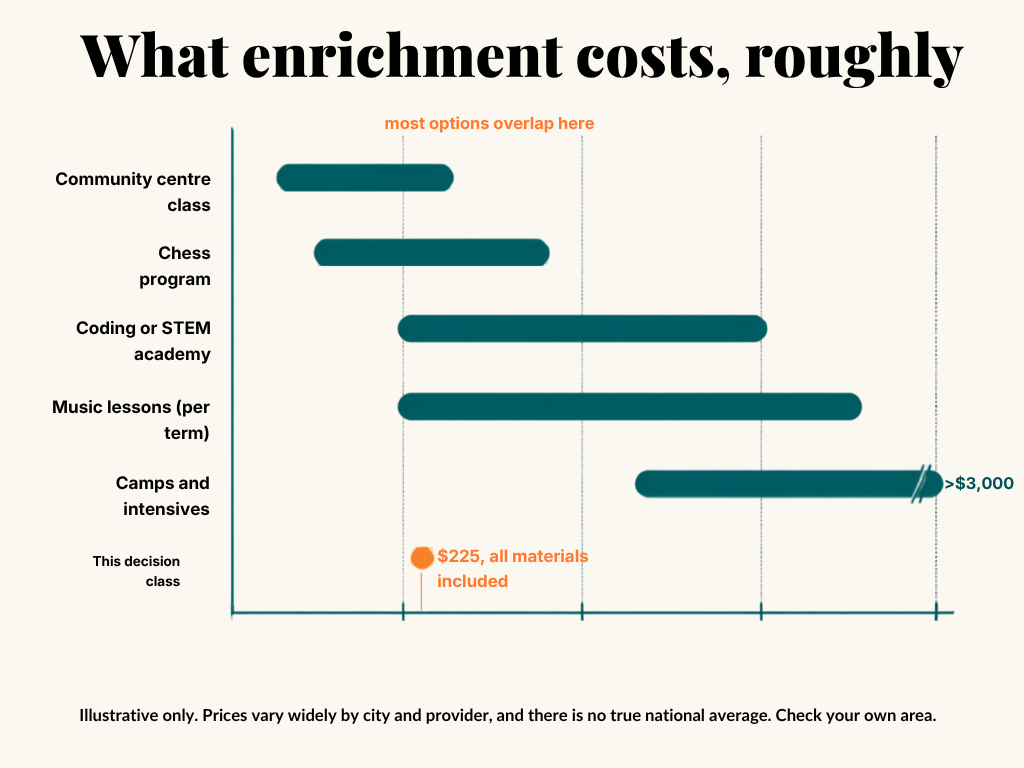
Canadian enrichment pricing is all over the map, so treat any figure here as illustrative and check your own city. A term of weekly, hour-long sessions at a community centre tends to sit at the low end, often roughly $100 to $250. Private specialized programs and coding academies run higher, into the few-hundreds per term. Camps and intensives climb into four figures. The spread inside any one category is wider than the gap between categories, which is the whole point.
If price cannot cleanly separate coding from chess from a decision class, then price is not the variable you are actually choosing on. The skill mix is. Pick the thinking you want your kid to walk away with, then find the version of it that fits your budget, rather than letting the cheapest open slot decide for you.
The case for money and data, made honestly
Here is the argument for the arena we teach in, and because it is ours, hold it to the incentive lens like everything else.
What makes money unusual as a place to practice thinking is not the money. It is the feedback. Almost every enrichment arena hands the kid either a right answer or a referee. Coding has a correct output. Chess has a rule that says checkmate. Debate has a judge who awards the round.
Money is the rare one where the kid’s own decision produces a real result that no one can overrule. A savings goal set in September is either reached by December or it is not, and the number does not care how the kid felt about it. That honest feedback is what turns a lesson into a skill, because the kid learns from a consequence they own rather than a grade someone handed down.
This is also where the AI question resolves cleanly. A machine will compute compound growth in a second and lay out every option. What it will not do is want the goal for your child, or sit with the disappointment of missing one. Framing the decision and owning the call, the two ends that stay human, are exactly what a money decision forces a kid to do. They have to decide what they want badly enough to wait for, then live with whether the plan worked.
It is also the one option on the table that keeps all three skills at once. Debate reaches deciding but leaves the numbers out. Coding runs the numbers but arrives with the problem already framed. A money decision makes a kid notice the choice, put real figures to it, and commit, which is why it lands in noticing, weighing, and deciding together rather than one at a time.
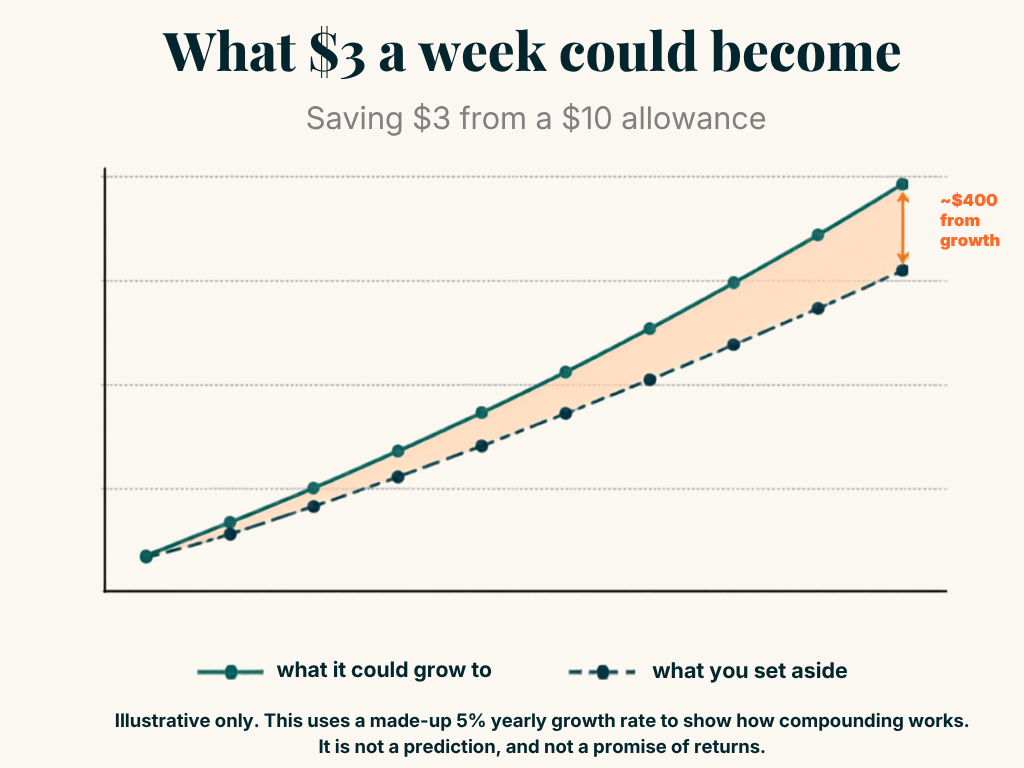
The method we use for it is deliberately plain: show the picture, then have them run the numbers themselves. A kid sees a simple chart of a small weekly amount growing, then works out their own version, say what saving $3 out of a $10 allowance reaches in a year. The figure is illustrative and the point is that the kid does the arithmetic, not that the number is exact. We do not tell them the answer. We hand them the calculator, because a number you worked out yourself is one you believe and one you can defend.
Now the honest limits, because a section that only sells is the kind we told you to distrust. This will not make your child a coder or a tournament chess player; it builds judgment, not a domain craft. It leans on what happens at home, so an hour on a Sunday plants a habit rather than transplanting one, and the habit grows only if the reasoning continues at the kitchen table. And the category is new and offered unevenly, so quality varies more than it does in coding or chess, where the field is mature. None of that disqualifies the arena. It means you are buying a way of thinking, with your own follow-through as part of the deal.
So no crown here either. If what you want is the coder’s precision, buy coding, to build the discipline of an instrument, buy music. And for developing the thinking the tools cannot do for your child, the noticing and the owning, this is the arena built around exactly that. That is the honest case, incentive and all.
Why we built this

We are two people who spent years working with numbers. And for a long time, one of us still could not read their own investment statements. I sat down one year to work out what I had actually paid in fees, and I simply could not find the number anywhere in the statement.
Not because the math was hard. The reports are built to be unreadable, and opacity is convenient for the people who produce them. That is not an accident. It is a business model.
Once you see it, you see it everywhere. When we asked our bank for the detailed records behind our mortgage payments, they were reluctant, until my partner mentioned that we keep our own records, code our own amortization models, and would call back the moment our balance and theirs disagreed by more than $500. The detail arrived quickly after that. An amortization model, if the term is new, is just a spreadsheet that tracks how each payment splits between interest and principal, so you always know what you owe and why. None of it required special access. It required being willing to check.
So we built this for the people who still have time to build that habit early. Children. We teach kids ages 9 to 12 to notice a choice clearly, reason through it with real numbers, decide with confidence, and then explain and defend the decision. Money is simply where they practice, because it is the most measurable, consequential decision a young person actually makes. A savings goal is either reached or it is not, and that honest feedback is what turns thinking into a skill.
Led by two PhD-level educators, including a formally trained math teacher, using the DataSavvy Method. Designed to develop confident thinkers through mathematics, data and real-world decisions.
Your child does not have to start from the confusion most of us did. They can grow up as someone who asks what a number is hiding, and who is willing to check it, before anyone can use the answer against them. That, more than any single subject, is the habit that outlasts every tool.
So which class should you pick?
The honest answer is the one this whole piece has been building toward: it depends on the thinking you want, and price is not what decides it. If you want a coder’s precision, coding still earns its place, more than the headlines suggest. To achieve an instrument’s discipline, music does something none of the others do. If the objective is for your child to develop the judgement that the tools cannot do for them, the noticing and the deciding, look for the arenas that reach all the way to a real, owned decision. Debate is one and reasoning through real money and data is the other, and it is the one built around that skill on purpose.
Whatever you choose, keep the habit from the middle of this piece. Ask who benefits when someone tells you what your kid must learn next, us included. A claim and a sales pitch can point the same direction and still be true, but it is worth checking a little harder before you hand over a term’s fee. Teaching your kid to run that same check is, in the end, the whole game.
If you are in Vancouver, our own version of this runs on eight Sundays this fall at Douglas Park Community Centre, Smart Money and Big Decisions, for ages 9 to 12. It is a small cohort, capped at twelve, registered through the centre, course number 634356. Registration is the centre’s, not ours. Link .
If you are anywhere else, you can try the method at home for nothing. The free three worksheets we use in class, three jars, a savings goal, and a growth chart, are enough to start the same noticing-and-deciding habit at your kitchen table.
Either way, the point is not to buy the right class. It is to make sure the thinking your kid practices is the kind that stays theirs.
Frequently asked questions
Money is the practice field, not the point. The skill is deciding well: noticing a choice, weighing it with real numbers, committing, and defending it. A kid who cares more about soccer or dinosaurs still makes decisions every day, and money is simply the arena where the feedback is honest, since a savings goal is either reached or it is not. If your child dislikes numbers entirely, that is worth knowing going in, because the reasoning is done with real figures.
Usually not, because they build different parts of thinking. Coding and chess live mostly in weighing options inside a system that has a right answer. This lives in framing the problem and owning a decision with real stakes, the parts those two tend to skip. If anything they pair well, one sharpens the mechanics of reasoning and the other the judgment around it.
Nine to twelve is the band this is built for. It is old enough to handle real arithmetic and a genuine trade-off, and young enough that the habit forms before money gets emotional and the patterns set. Under nine, the same ideas work better as simple games at home. Over twelve, the conversation shifts toward budgeting and earning, which is a different piece.
No, but your follow-through matters more than your expertise. The research on children and money points in one clear direction: what sticks is ongoing conversation and involvement at home, more than any single lesson or a parent having the perfect answer. An hour on a Sunday plants the habit. A few kitchen-table questions afterward are what grow it, and those do not require you to be an expert.
Then the in-person course is not available to you, and that is a real limit worth stating plainly. The method itself is not locked to the room. The three worksheets we use in class, three jars, a savings goal, and a growth chart, are meant to start the same noticing-and-deciding habit at home.
Sources
- Canadian Securities Administrators and CIRO, Client Focused Reforms (Joint Staff Notice 31-368), on the suitability standard for registrants. Link
- Sala, G. and Gobet, F. (2017). Does Far Transfer Exist? Negative Evidence From Chess, Music, and Working Memory Training. Current Directions in Psychological Science, 26(6), 515 to 520. Link
- LeBaron, A. B. and Kelley, H. H. (2021). Financial Socialization: A Decade in Review. Journal of Family and Economic Issues. Link
- Simon, H. A. (1960). The New Science of Management Decision. The intelligence, design, and choice model of decision-making.
- Facione, P. A. (1990). Critical Thinking: A Statement of Expert Consensus for Purposes of Educational Assessment and Instruction (The Delphi Report). American Philosophical Association. Link
Data Savvy Kids is the youth branch of Data Savvy Finance. This article contains no affiliate links, and we earn nothing if you choose one enrichment option over another. Where we mention our own course, registration is handled by Douglas Park Community Centre, not by us. The content here is educational, not financial or investment advice, and any numbers are illustrative rather than guaranteed. We try to be exact and to flag every figure as illustrative. If you spot an error, tell us and we will fix it. See our full affiliate disclosure.