Questrade vs Wealthsimple (2026): Fees, Accounts and Who Each Fits
Both now charge $0 to trade ETFs. Here is where Questrade and Wealthsimple still differ in 2026, in dollars: US-dollar costs, automation, managed portfolio fees and TFSA transfers.
By Biljana Jonoska Stojkova, founder of DataSavvy Finance · Fees checked October 9, 2026 · Updated October 12, 2026
Disclosure: This article contains no affiliate links. Every link to Questrade or Wealthsimple goes to the platform’s own public page, and I’m not paid by either for this comparison. If that ever changes, this note will say so before the first link. This article is educational and isn’t investment advice. How I research these comparisons
Introduction
Commissions used to settle this comparison. Questrade let you buy ETFs for free but charged $4.95 to $9.95 to sell, while Wealthsimple charged nothing either way. That gap has closed: Questrade now charges $0 to buy and sell Canadian and US-listed stocks and ETFs online, the same as Wealthsimple.
What’s left are smaller, more specific differences: what it costs to hold US dollars, how much of your investing can run without you, and what you pay if you’d rather someone else manage the portfolio. Which of those matters depends on what you buy and how you like to invest, so this guide puts a dollar figure on each one and leaves the decision with you.
This content is for educational purposes only and does not constitute investment advice or platform endorsement.
In this guide: At a glance · Fees · Pricing tiers and less obvious fees · For a TFSA · For an RRSP · For US stocks · Managed portfolios · Pros and cons · For beginners · What Reddit says · Before you choose · FAQ
How I researched this comparison
I hold accounts at both platforms, so part of this comparison is my own experience and part is each platform’s published fees. At Questrade, I hold a US-dollar RRSP and a TFSA, and I transferred accounts in from my old institution. At Wealthsimple, I opened an RRSP from scratch for Canadian-listed ETFs.
For anything I haven’t used, like managed portfolios, options or Wealthsimple’s US-dollar accounts, I checked the platform’s own pricing and help pages and linked each figure. I read third-party reviews to find questions worth asking, but none of them is the source for a number here.
In the tables, Used it means I’ve done it in my own account. Verified means I confirmed it on the platform’s official page on the date shown. I don’t rank platforms or name a winner. The full method, including how I get paid and how I handle corrections, is on my methodology page.
At a glance: where the two platforms differ
Here’s the short version. Everything in this table is explained, with sources, further down.
| Questrade | Wealthsimple | |
|---|---|---|
| Cost to trade ETFs | $0 to buy and sell, Canadian and US-listed | $0 to buy and sell |
| Account fee / minimum | $0 / none | $0 / none |
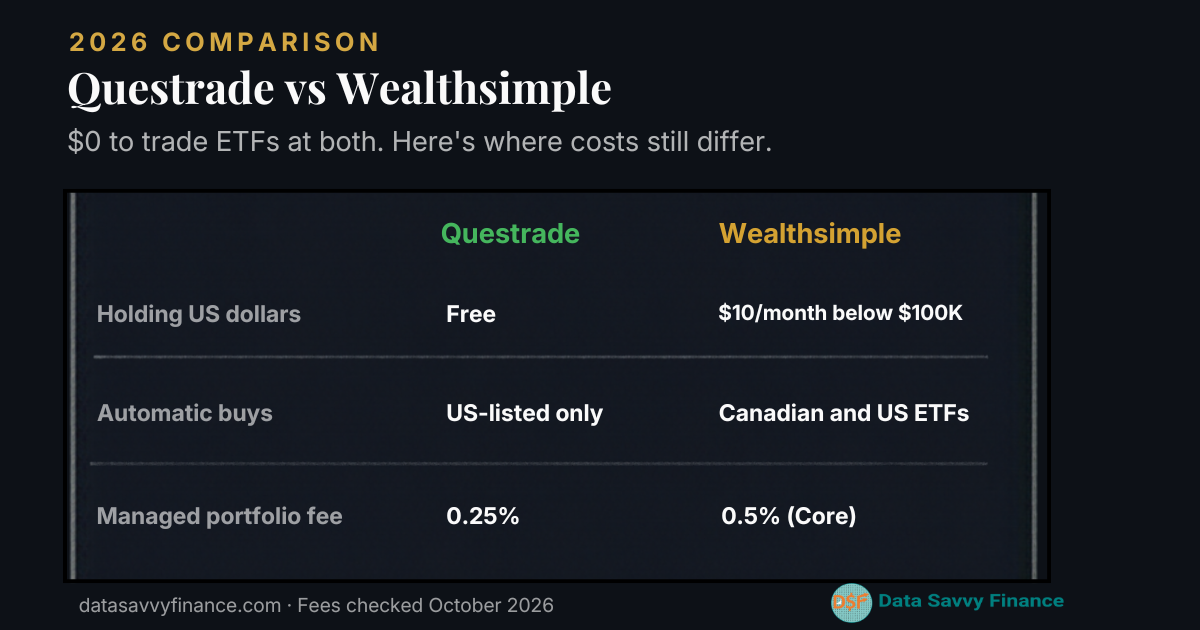
| Holding US dollars | Free: every account has a separate US-dollar side | $10/month on Core after a 30-day trial, free at $100K+ in total assets |
| Currency conversion | 1.5%, or Norbert’s Gambit ($9.95 journalling fee) | 1.5% without a USD account, 1.5% to 0% by size with one. Norbert’s Gambit: $9.95 plus tax, web only, USD account required |
| Fractional shares | Eligible Canadian and US stocks and ETFs | Canadian and US stocks and ETFs, from $1 |
| Automatic recurring buys | Eligible US-listed fractional securities only | Canadian and US stocks and ETFs |
| Managed portfolio fee | Questwealth: 0.25% ($250 to $99,999), 0.20% ($100K+) | 0.5% Core, 0.4% Premium, 0.2% to 0.4% Generation |
| Account types | TFSA, RRSP, spousal RRSP, FHSA, RESP, LIRA, LIF, RRIF, margin, corporate | TFSA, RRSP, spousal RRSP, FHSA, RESP, RRIF, LIRA, margin, business. LIF offered in the app |
| Tends to suit | Investors who hold US-listed ETFs and want to keep US dollars without a monthly fee, or want the lower managed fee | Investors who buy Canadian-listed ETFs on a schedule and want each contribution invested automatically |
| Honest drawback | Canadian ETF buys are placed by hand, and moving an account out to another institution costs $150 | Holding US dollars costs $120 a year below $100K in assets, and its Norbert’s Gambit needs that paid USD account |
Fees checked October 9, 2026, account types and features October 11, 2026. This table compares platform features for educational purposes only and is not investment advice or a platform endorsement. Features change, so confirm on each platform’s site.
If you only buy Canadian-listed ETFs, the two cost the same, so the real question is how you like to invest. On my Wealthsimple RRSP, contributions get invested automatically. On Questrade, I place each buy myself.
If you plan to hold US-listed ETFs or convert currency more than once or twice a year, Questrade’s free US-dollar side saves you $120 a year compared with Wealthsimple’s Core plan, until your Wealthsimple assets reach $100,000.
If you want someone else to choose and rebalance your ETFs, Questwealth’s management fee is half of Wealthsimple Core’s below $100,000: $125 versus $250 a year on $50,000.
If you want to compare the current account options on each platform’s own site, here they are side by side: Questrade’s self-directed investing page and Wealthsimple’s pricing page. Neither is an affiliate link.
What each platform actually is
Questrade has operated since 1999 and is a Canadian independent online brokerage. Its main product is self-directed investing: you choose the ETFs, place the trades and manage your own mix. It also runs Questwealth Portfolios, a managed option where Questrade’s team builds and rebalances an ETF portfolio for you.
Wealthsimple, founded in 2014, offers the same two styles in one app:
Managed investing (long known as Wealthsimple Invest): you answer a risk questionnaire, deposit money, and Wealthsimple builds and rebalances the portfolio for an annual management fee.
Key distinction. Both companies offer self-directed and managed investing. Comparing “Questrade vs Wealthsimple” without saying which style you mean leads to wrong conclusions: the self-directed accounts cost $0 a year to hold ETFs, while the managed ones charge a management fee on top of the ETFs’ own costs.
Fees in 2026: what actually differs now
Trading commissions
Both platforms now charge $0 to buy and sell Canadian and US-listed stocks and ETFs online (Questrade, Wealthsimple). If you read an older comparison that says Questrade charges $4.95 to $9.95 to sell, that’s out of date. Neither charges an account fee or requires a minimum deposit for self-directed accounts.
Currency
Currency conversion is the one fee that still separates the two platforms, and only if you buy US-listed stocks or ETFs. It has its own section below: Questrade vs Wealthsimple for US stocks.
Managed portfolio fees
Both managed options charge a management fee on top of the MER (management expense ratio, the yearly cost) of the ETFs inside. Questwealth charges 0.25% on $250 to $99,999 and 0.20% above that. Wealthsimple charges 0.5% on Core, 0.4% on Premium ($100,000+ in total assets) and 0.2% to 0.4% on Generation ($500,000+). The dollar comparison is in the managed portfolios section below. To see what a fee gap adds up to over decades, try the investment growth calculator.
Pricing tiers, subscriptions and the less obvious fees
WordPress: set this heading’s HTML anchor to “pricing”.
Both platforms advertise $0 commissions, and for most ETF investors that’s the headline that matters. But each one has a second layer of pricing: Wealthsimple through its client tiers, Questrade through an optional subscription. Here’s what each layer actually changes for someone holding ETFs.
Wealthsimple: Core, Premium and Generation
Your tier is set by whichever is higher, your net deposits or your total Wealthsimple portfolio value, across almost every account you hold there, including chequing (pricing). Commissions, recurring investments, DRIP, fractional shares and real-time quotes are the same on every tier. What changes for an ETF investor:
| Core ($1+) | Premium ($100,000+) | Generation ($500,000+) | |
| USD account | $10/month plus tax after a 30-day trial | Included | Included |
| Conversion fee in a CAD account | 1.5% | 1.5% | 1.5% |
| Managed investing fee | 0.5% | 0.4% | 0.4%, falling to 0.2% at $10M+ |
| Tax-loss harvesting (managed) | No | Yes | Yes |
| Support | 24/7 chat | 24/7 chat, priority phone | 24/7 chat, priority phone and email |
Checked October 11, 2026 on Wealthsimple’s pricing page. Verified.
The honest take: for a self-directed investor buying only Canadian-listed ETFs, Core costs nothing and the tiers barely matter. The $100,000 Premium line matters if you want US dollars, because it removes the $120 a year USD account fee, or if you use managed investing, where it cuts the fee by a fifth. Because status counts deposits across accounts, consolidating at one platform can cross that line sooner. That’s a real benefit, and also exactly what the tiers are designed to encourage.
Questrade: Questrade Plus
Questrade’s self-directed pricing has no tiers. Instead there’s an optional subscription, Questrade Plus, which costs $19.99 a month plus tax after a 30-day trial. It was free for everyone until September 30, 2026, and began billing on October 1 for anyone who didn’t cancel (Plus changes). It includes unlimited online journalling (normally $9.95 each), a 1% match on RRSP contributions, expanded market data with live options pricing, cashback on US options and a set of partner perks (Plus FAQ). Questrade Reserve clients get it free, though the page doesn’t state Reserve’s criteria.
Does it pay for itself? In dollars, Plus costs about $240 a year before tax ($19.99 × 12). Check the RRSP match terms before counting on that benefit, since they decide whether it pays you back. The journalling benefit covers it only if you’d otherwise journal about two dozen times a year ($240 ÷ $9.95). For a buy-and-hold ETF investor making ordinary contributions and an occasional Norbert’s Gambit, the math usually doesn’t get there. Stock and ETF trades are $0 with or without it.
If you had a Questrade account over the summer, check whether Plus is still active. The free period ended September 30, 2026, and billing started automatically on October 1 for subscribers who didn’t cancel.
The less obvious fees, side by side
None of these show up in a “$0 commissions” headline. Most investors will never pay most of them, but it’s better to know before you need one.
| Fee | Questrade | Wealthsimple | When you’d pay it |
| Currency conversion | 1.5% (fees) | 1.5% in a CAD account, 0% to 1.5% by size in a USD account (pricing) | Buying or selling US-listed securities |
| Holding US dollars | $0 | $10/month plus tax on Core | Keeping USD between trades |
| Journalling shares (Norbert’s Gambit) | $9.95, or free with Questrade Plus (fees) | $9.95 plus tax, web only, USD account required (help) | Converting currency without the 1.5% fee |
| Transferring an account out | $150, full or partial (fees) | $0 (fee schedule) | Leaving for another institution |
| Closing an account | Not listed | $0 | Closing without transferring |
| RRSP deregistration | $100 full, $50 partial | Not listed on the pages checked | Withdrawing everything from an RRSP |
| Instant withdrawal to debit card | Not listed | 2.5% | Skipping the 1 to 3 day standard withdrawal |
| Paper statement | $20 per copy | $20 | Requesting paper instead of electronic |
| Wire transfer | $20 CAD, $30 USD | CA$15 for CAD wires, US$15 for USD wires (help) | Sending money by wire instead of EFT |
| Optional subscription | Questrade Plus, $19.99/month plus tax | None for ETF investors (tiers are free) | Only if you opt in |
From each platform’s official fee schedule and pricing page, checked October 11, 2026. Verified.
Which pricing fits which investor, in numbers. If you buy Canadian-listed ETFs and never touch US dollars, both platforms are $0 and nothing in this table applies to you. If you hold US dollars below $100,000 in assets, Questrade saves you $120 a year. If there’s a chance you’ll move your account later, Wealthsimple saves you $150 on the way out. And if you’re weighing Questrade Plus, check its RRSP match terms against your own contributions before the trial ends.
Account types available
For most people opening a TFSA, RRSP or FHSA, this used to be a tiebreaker in Questrade’s favour. It isn’t anymore.
Questrade‘s account page lists TFSA, RRSP, spousal RRSP, FHSA, RESP, LIRA, LIF, RRIF, cash, margin, corporate and trust accounts (account types). Its accounts hold Canadian and US dollars side by side.
Wealthsimple‘s own account table, updated October 9, 2026, lists TFSA, RRSP, spousal RRSP, FHSA, RESP, RRIF and LIRA, each available as either a managed or a self-directed account, plus non-registered, margin and business accounts (Wealthsimple Help Centre). When I checked inside the app in October 2026, LIF was offered too, though it isn’t on that table yet.
One difference worth knowing if you’re planning for retirement: Wealthsimple’s table shows every registered account can hold US dollars except the RRIF. If you plan to keep US-listed investments after converting your RRSP to a RRIF, check how each platform handles that before you convert.
Platform experience: what using each one feels like
Questrade
Questrade has a web platform and a mobile app, QuestMobile, with real-time quotes, several order types, watchlists and research tools. It’s data-rich rather than simplified, and there’s a learning curve, though most of the complexity sits in options and margin features a buy-and-hold ETF investor never needs.
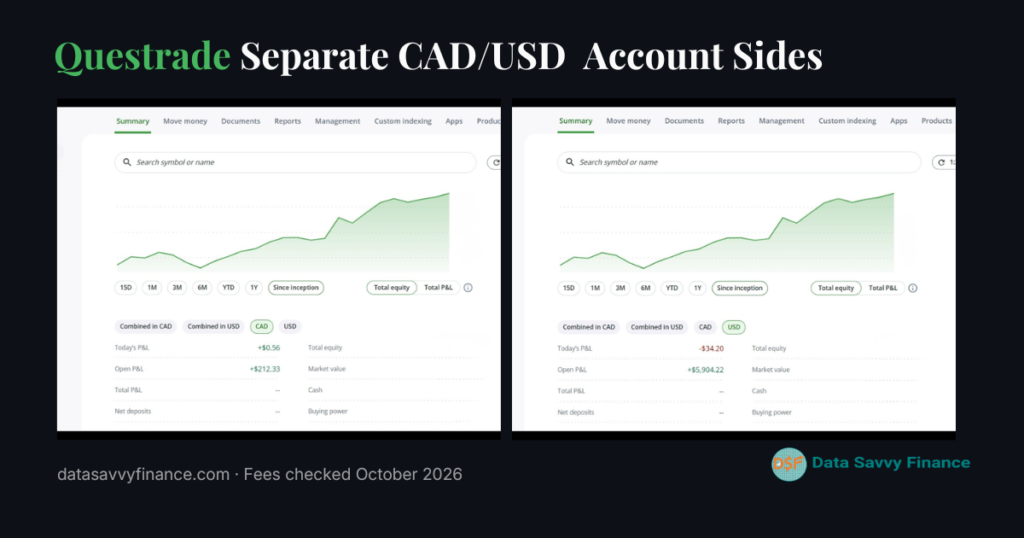
In my accounts, the US-dollar side shows up as its own balance: you can hold the cash or spend it on US-listed ETFs. I use limit orders there regularly. A limit order sets the highest price you’ll pay when buying, so a thinly traded ETF can’t fill at a bad price. My deposits arrive automatically every month, but I place each buy myself. Questrade does offer fractional shares on eligible Canadian and US stocks and ETFs, but its automatic recurring buys currently cover eligible US-listed fractional securities only.
Wealthsimple (self-directed)
Wealthsimple’s app is built around simplicity: search for an ETF, enter an amount, buy. It isn’t stripped of tools, though. Limit orders are available, and the order screen shows you the bid and ask before you submit.
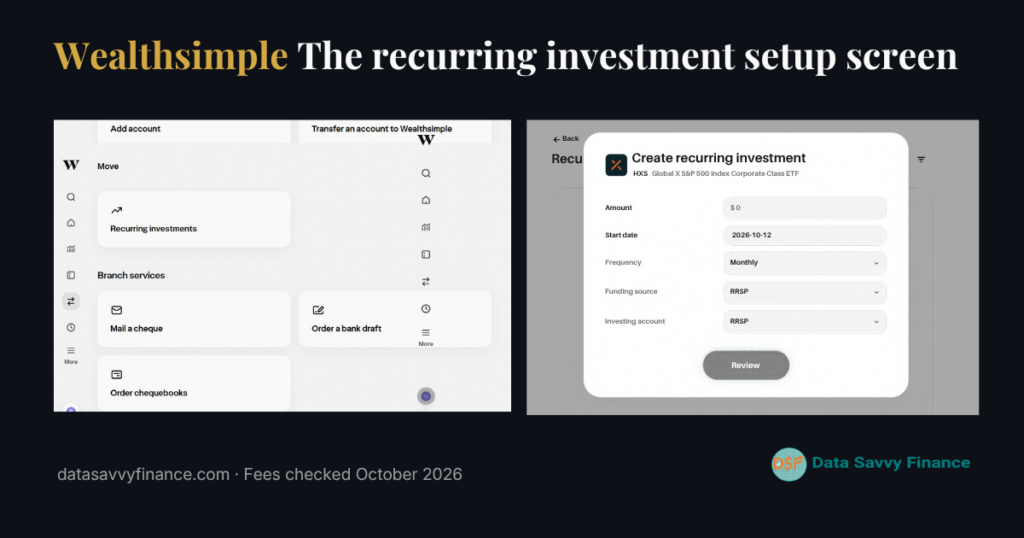
The difference I notice most is automation. On my Wealthsimple RRSP, contributions arrive and get invested automatically, fractional shares included, so a $200 contribution (an illustrative amount) buys $200 of an ETF without me placing a trade. Both platforms reinvest my dividends through DRIP, a dividend reinvestment plan.
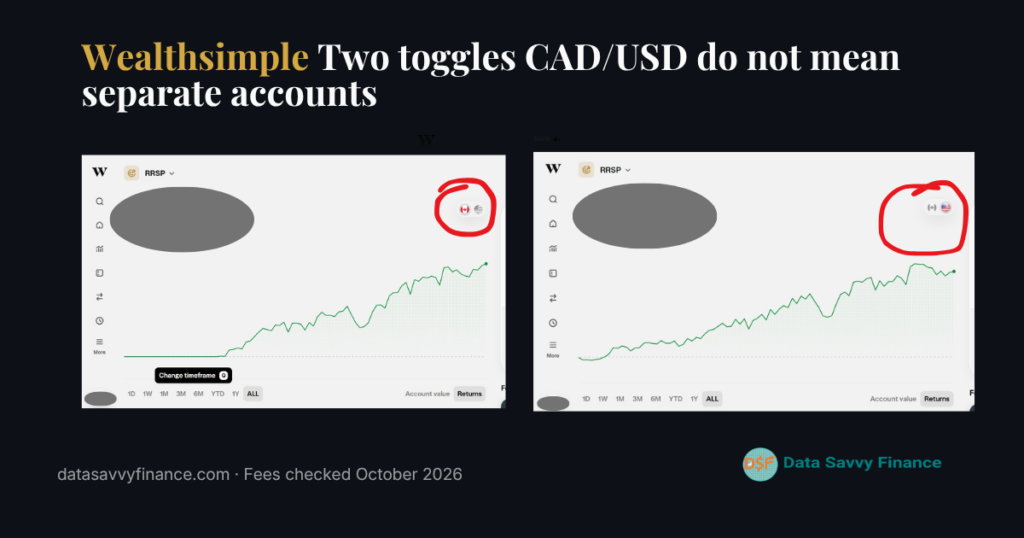
Wealthsimple’s summary page has a CAD/USD switch, and it’s easy to misread. As far as I can tell, it only changes how your balance is displayed on the chart. It doesn’t convert or hold anything. I keep everything in Canadian dollars there. Holding actual US dollars takes the USD account described above.
Managed investing (both platforms)
Questwealth and Wealthsimple’s managed investing are the most hands-off option: answer a questionnaire, deposit, and the platform handles allocation, rebalancing and dividend reinvestment. I haven’t used either, so everything about them here comes from their published pages. The management fee is what you pay for that automation, and it’s worth putting into dollars before you choose it, which the managed portfolios section below does.
Regulation and account safety
Both platforms are regulated by CIRO, the Canadian Investment Regulatory Organization, which oversees investment dealers in Canada. Both are also members of the Canadian Investor Protection Fund (CIPF), which covers eligible client assets up to $1 million per account category if a member firm becomes insolvent.
The categories matter more than most comparisons let on. According to CIPF’s own brochure, your TFSA, FHSA, cash and margin accounts all share one $1 million “general” limit. RRSPs, RRIFs, LIRAs and LIFs share a separate $1 million retirement limit, and RESPs have their own. So a large TFSA and a large non-registered account at the same firm are covered together, not separately.
Questrade has operated since 1999 and Wealthsimple since 2014. The founding year doesn’t change CIPF coverage: eligible assets are protected the same way at both.
Transferring accounts from a bank
Moving an existing TFSA or RRSP to either platform doesn’t trigger tax, and your contribution room is preserved, as long as it’s a direct transfer. You fill out a transfer request on the new platform, and it contacts your old institution for you.
When I moved my accounts into Questrade, it took roughly two to three weeks, as I remember it. My old institution charged $146 to transfer about $28,000, and Questrade reimbursed $52.50 of it, so I paid the other $93.50 myself. Its TFSA page today says only that it might reimburse transfer-out fees, subject to minimum transfer amounts and proof of the fee, with no amount stated, so ask before you start if the fee matters to you.
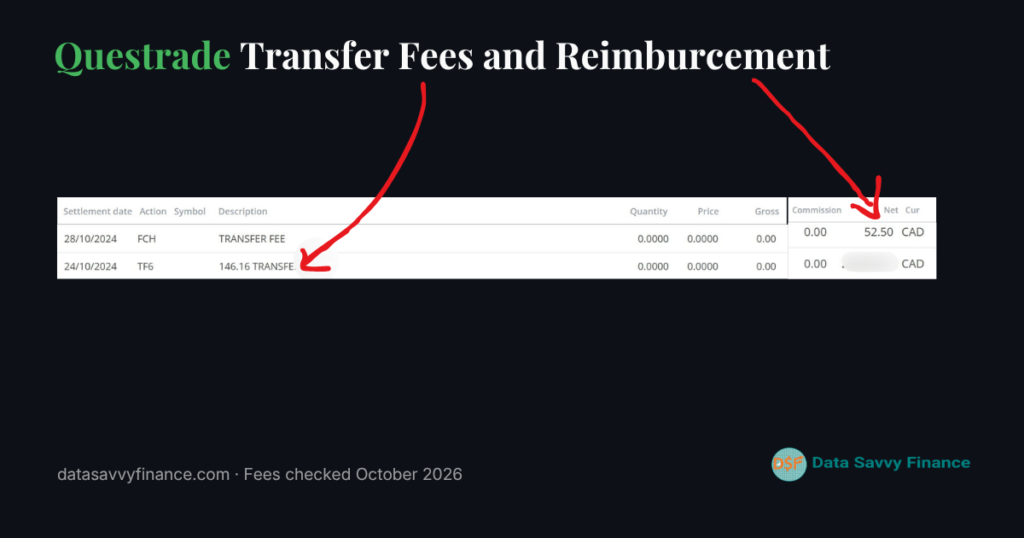
Wealthsimple publishes a clearer rule: up to $150 back per account when you transfer $25,000 or more, with proof of the fee (transfer page). I opened my Wealthsimple RRSP from scratch, so I haven’t tested that one myself. Check your current institution’s fee schedule for its transfer-out fee. Mine was $146.
It’s worth checking the exit cost too, before you’re in. Questrade charges $150 to transfer an account out to another institution, full or partial (administrative fees). Wealthsimple charges $0 for outgoing transfers and $0 to close an account (fee schedule). Wealthsimple’s own reimbursement policy adds two conditions to its $150 rule: the money has to stay for 90 days, and only the administrative transfer-out fee qualifies, not deferred sales charges or closing fees (reimbursement policy).
Don’t withdraw and re-deposit to move a registered account. A TFSA withdrawal only adds back to your contribution room on January 1 of the following year (CRA), so re-depositing the same year can put you over your limit, and an RRSP withdrawal triggers withholding tax.
If your current account holds bank mutual funds with MERs of 1.5% or more, compare that cost to a low-cost ETF before you transfer. ETF fees vs mutual fund fees in Canada walks through the difference in dollars.
Questrade vs Wealthsimple for a TFSA: fees, USD and transfers compared
If you’re deciding between Wealthsimple and Questrade for a TFSA, the basics are now almost identical. Neither charges commissions on Canadian or US-listed ETFs, and neither charges an annual TFSA fee. The real differences show up in three places: what it costs to hold US dollars, whether your old institution’s transfer fee gets reimbursed, and how much money you need before some perks kick in.
Here’s how they compare. I checked every figure on October 9, 2026.
| Feature | Questrade (self-directed TFSA) | Wealthsimple (self-directed TFSA) | How I know |
| Annual account fee | $0 (Questrade pricing) | $0 on all plans (Wealthsimple pricing) | Q: Used it. WS: Verified |
| Account minimum | None for self-directed accounts ($0 commissions FAQ) | $0 (Wealthsimple pricing) | Verified |
| ETF commissions (buy and sell, online) | $0 for Canadian and US-listed stocks and ETFs ($0 commissions FAQ) | $0 (Wealthsimple pricing) | Q: Used it. WS: Used it (RRSP) |
| Hold US dollars inside the TFSA | Yes, accounts are dual-currency (CAD and USD) at no extra charge (currency conversion lesson) | Yes. Free on Premium ($100K+) and Generation ($500K+). On Core it’s $10/month after a 30-day trial (USD accounts help article) | Verified |
| Currency conversion fee | 1.5% (transaction fees) | With a USD account: 1.5% under $10K, 1.0% from $10K, 0.5% from $25K, 0% from $100K per conversion. Without one: 1.5% on every US trade (Wealthsimple pricing) | Verified |
| Transfer-in fee coverage | “Might reimburse” transfer-out fees, subject to minimum transfer amounts and proof of the fee. No amount stated (Transfer TFSA to Questrade) | Up to $150 per account when you transfer $25,000 or more, with proof of the fee (transfer page) | Q: Used it (reimbursed $52.50 of my $146 fee) and Verified. WS: Verified |
Fees change. Confirm on each platform’s site before opening an account.
What the table means for a typical TFSA investor
If you only buy Canadian-listed ETFs, the two platforms cost the same: $0 to open, $0 a year and $0 per trade. Plenty of Canadian ETFs hold US and global stocks while trading in Canadian dollars, so you never have to convert currency. All-in-one asset allocation ETFs are one common example, and my asset allocation ETF guide compares four of them. For this investor, the decision comes down to which app you’d actually open and use, and whether you want contributions invested automatically.
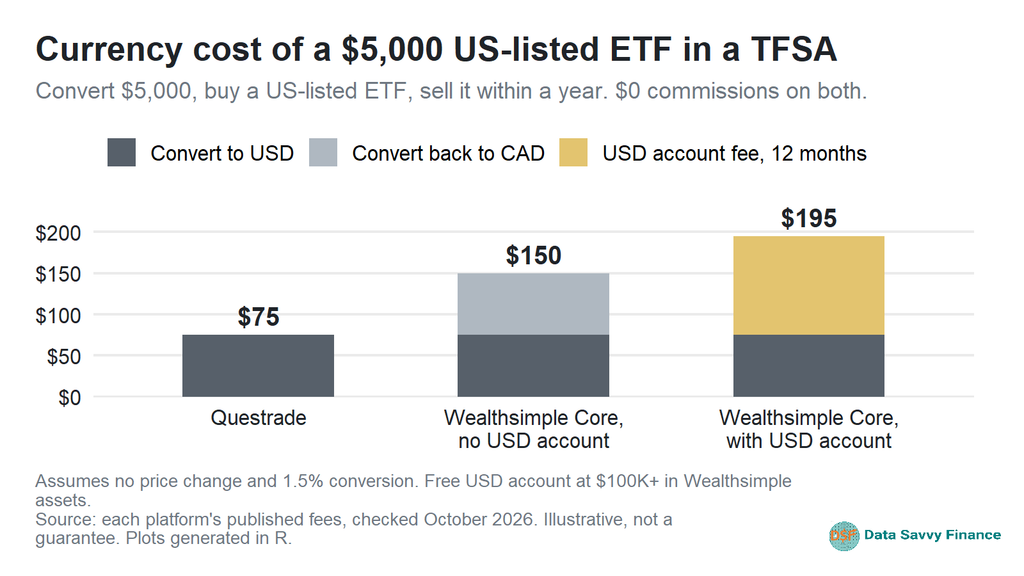
If you want to buy US-listed ETFs, currency becomes the main cost. Here’s the math on converting $5,000 to buy a US-listed ETF:
- Questrade at 1.5%: about $75 ($5,000 × 1.5%). After that, the USD stays in your TFSA, and later trades or dividends don’t need converting again.
- Wealthsimple Core without a USD account: about $75 each time you buy, and the proceeds are converted back to CAD when you sell.
- Wealthsimple Core with a USD account: about $75 on the conversion, plus $120 a year for the USD account after the trial. That’s free if your total Wealthsimple assets are $100K or more.
US-listed ETFs in a TFSA have a tax wrinkle too: the US withholds 15% of dividends paid into a TFSA, because the US tax treaty doesn’t recognize TFSAs (it does recognize RRSPs). That applies at both platforms, so it doesn’t change this comparison, but it matters when you’re deciding which account to hold which ETF in. My low-cost RRSP ETF portfolio case study shows how I handled withholding tax in my own RRSP.
If you’re moving an existing TFSA, check the fee your current bank charges to transfer it out. Wealthsimple publishes a clear rule: $25,000 or more gets up to $150 back per account. When I transferred in, Questrade reimbursed $52.50 of my $146 fee, which fits its own wording that it might reimburse. Ask Questrade before you start how much it will cover for your transfer.
Either way, request a direct transfer between institutions. Don’t withdraw the money and re-deposit it. A withdrawal-and-redeposit in the same year can count against your contribution room and trigger CRA’s 1% per month tax on the excess (CRA).
Contribution room: use CRA as your source of truth
Neither platform knows about TFSA contributions you’ve made at other institutions, so neither can be the final word on your room. Check your available room in CRA My Account, and remember CRA’s figure only updates once a year. My Questrade TFSA guide walks through how room builds up from 2009 onward.
Small fees, big difference over time
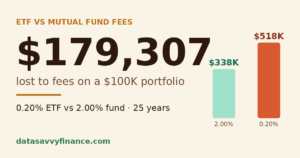
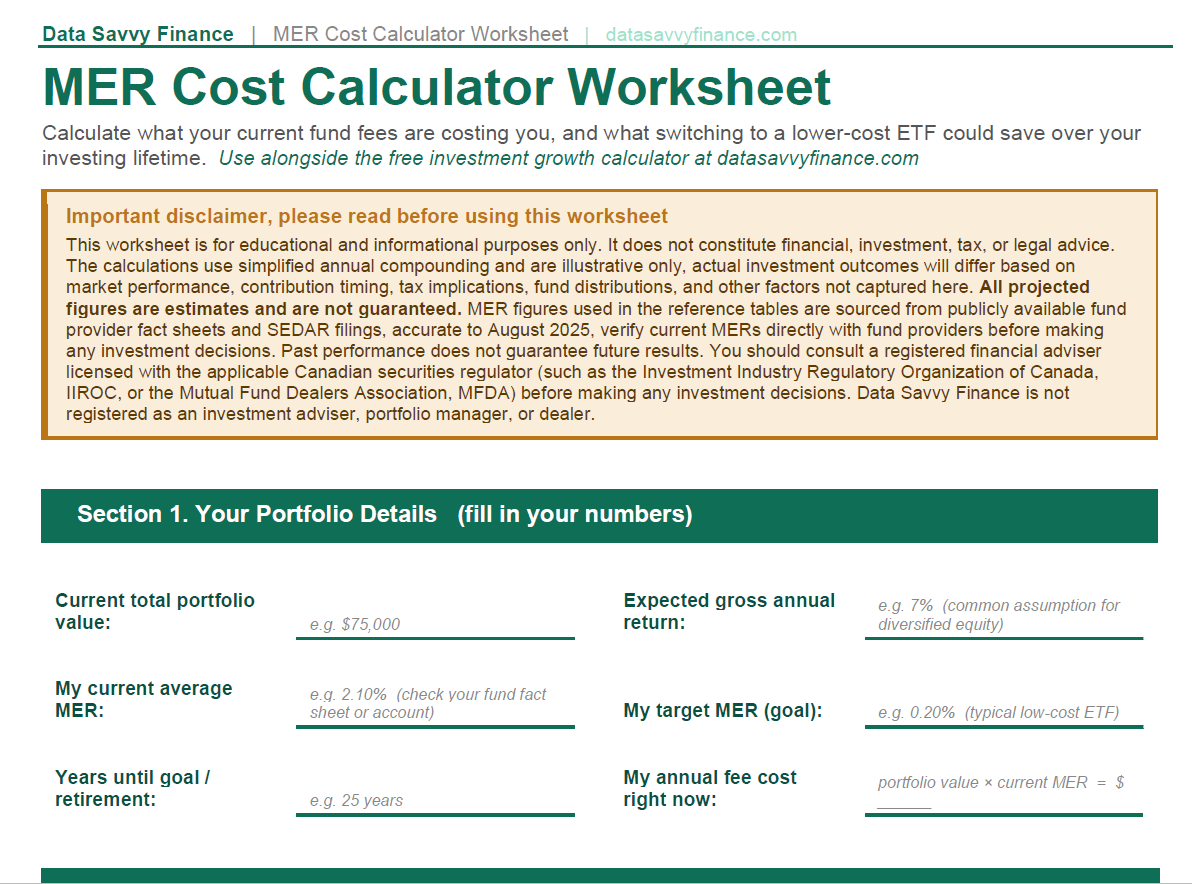
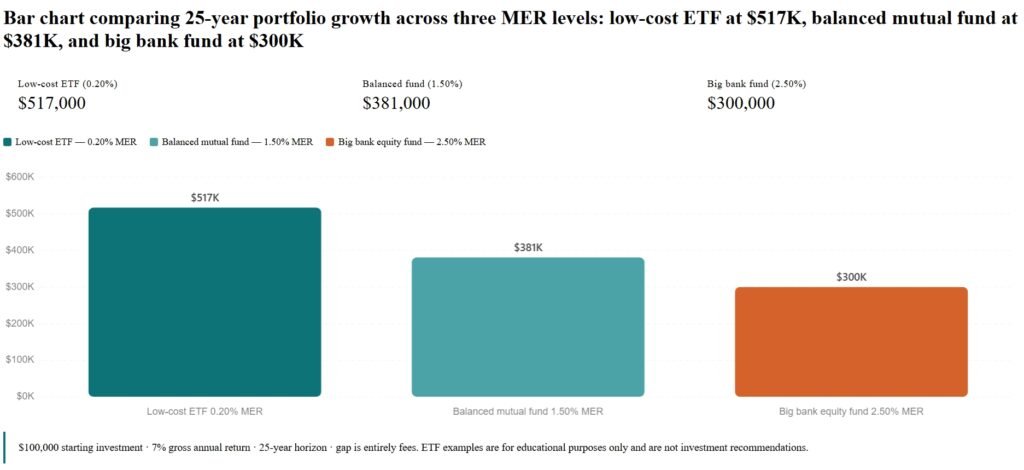
Both platforms are now cheap enough that the bigger long-term cost is usually the MER of the ETF you choose. In the example from my Questrade TFSA guide, $100,000 left for 25 years at an illustrative 7% return grows to about $517,000 with a 0.20% MER and about $381,000 with a 1.50% fund fee. The roughly $136,000 gap is entirely fees. Illustrative, not a forecast (what a good MER looks like). If you’d rather have this math in a sheet you can keep, I’ll email you the free MER cost worksheet. It shows what your current fund fees cost over 10, 20 and 30 years. You can unsubscribe anytime.
Questrade vs Wealthsimple for an RRSP
For an RRSP, the basics match again: $0 to trade, no account fee, and both offer RRSPs and spousal RRSPs as self-directed or managed accounts (Questrade, Wealthsimple). The difference that matters more in an RRSP than anywhere else is US dollars, because of how the US taxes dividends.
Why US dollars matter more in an RRSP
When a US company pays a dividend into a TFSA, FHSA, RESP or non-registered account, the US keeps 15%. In an RRSP, RRIF, LIRA or LIF, US dividends are generally subject to zero withholding, because the Canada-US tax treaty recognizes retirement accounts (Wealthsimple Help Centre). The catch that trips people up: a Canadian-listed ETF that holds US stocks pays that 15% at the fund level, and it can’t be recovered, even inside an RRSP. To get the exemption, you have to hold the US stocks or US-listed ETFs directly, which means holding US dollars.
In dollars, with illustrative numbers: $50,000 in US stocks yielding 1.5% pays $750 a year in dividends. At 15%, that’s $112.50 a year lost in a TFSA, or through a Canadian-listed ETF in an RRSP. Held directly in US dollars inside an RRSP, it’s generally $0.
Where the two platforms differ
Getting the US dollars in is the cost. At a 1.5% conversion fee, converting $50,000 costs $750, which takes almost seven years of $112.50 savings to earn back. With Norbert’s Gambit at roughly $10 plus the spread, it’s earned back in about a month. That’s the reason my Questrade RRSP is the one that holds US dollars. When I funded it in 2024, I converted $20,000 CAD with the gambit. It took about a week from the first buy to the final sale, and the fees in my records came to about $25 CAD. At 1.5%, the same conversion would have cost about $300.
At Wealthsimple, the RRSP can hold US dollars too (account table), but on the Core plan the USD account costs $120 a year. On the $50,000 example, that’s more than the $112.50 the exemption saves. Above $100,000 in total Wealthsimple assets the USD account is included, and the fee drops out of the math.
My Wealthsimple RRSP takes the other approach. I opened it from scratch for Canadian-listed ETFs, so there’s no currency to manage, and each contribution is invested automatically. The trade-off is the unrecoverable 15% on the US portion of those ETFs. My RRSP case study covers the swap-based ETF I hold in that Wealthsimple RRSP to reduce the drag while keeping everything in Canadian dollars.
ETF examples are provided for educational purposes only and are not investment recommendations or endorsements. Comparable products from other providers may exist.
Later on: withdrawals and converting to a RRIF
RRSP withdrawals carry withholding tax at either platform, because that rule comes from CRA, not the brokerage. Questrade charges $100 to deregister a full RRSP and $50 for a partial one (administrative fees). Wealthsimple’s fee schedule doesn’t list one. When you convert to a RRIF, note that Wealthsimple’s RRIF can’t hold US dollars, so a US-dollar RRSP there would need converting back first. If you hold US dollars at Questrade, ask how its RRIF handles them before you convert.
Questrade Plus also includes a 1% match on RRSP contributions. The pricing section covers what the subscription costs.
Questrade vs Wealthsimple for US stocks and US-listed ETFs
Commissions are $0 on US-listed stocks and ETFs at both platforms, so the entire difference here is currency: what it costs to get US dollars, hold them and convert back. If you only want US exposure and not US-listed securities, a Canadian-listed ETF that holds US stocks avoids all of this, with the withholding-tax trade-off covered in the RRSP section above.
Getting and holding US dollars
- Questrade charges 1.5% to convert (fees). Every account has a separate US-dollar side at no extra cost, so once you’ve converted, you can hold the US cash or spend it on US-listed ETFs without converting again.
- Wealthsimple charges 1.5% on every US trade if you don’t have a USD account, converting each buy and each sale. A USD account costs $10 a month on the Core plan after a 30-day trial and is free once your total Wealthsimple assets reach $100,000 (USD accounts). With one, conversion fees drop by size: 1.5% under $10,000, 1.0% from $10,000, 0.5% from $25,000 and 0% from $100,000 per conversion.
Norbert’s Gambit is a way to convert currency without the percentage fee. You buy a security that trades in both Canadian and US dollars, then sell it in the other currency. Most people use DLR and DLR.U, a pair built for this. Instead of 1.5%, you pay a flat fee to journal (move) the shares from DLR to DLR.U, the bid-ask spread, and a short wait while the trades settle, during which DLR’s price can move a little.
Questrade’s fee schedule lists $9.95 for journalling shares (administrative fees), and its optional Questrade Plus subscription includes unlimited online journalling (more on that in the pricing section below). I’ve used it at Questrade on conversions of around $10,000 and up, because a percentage fee bites harder the bigger the amount: 1.5% on $10,000 is $150.
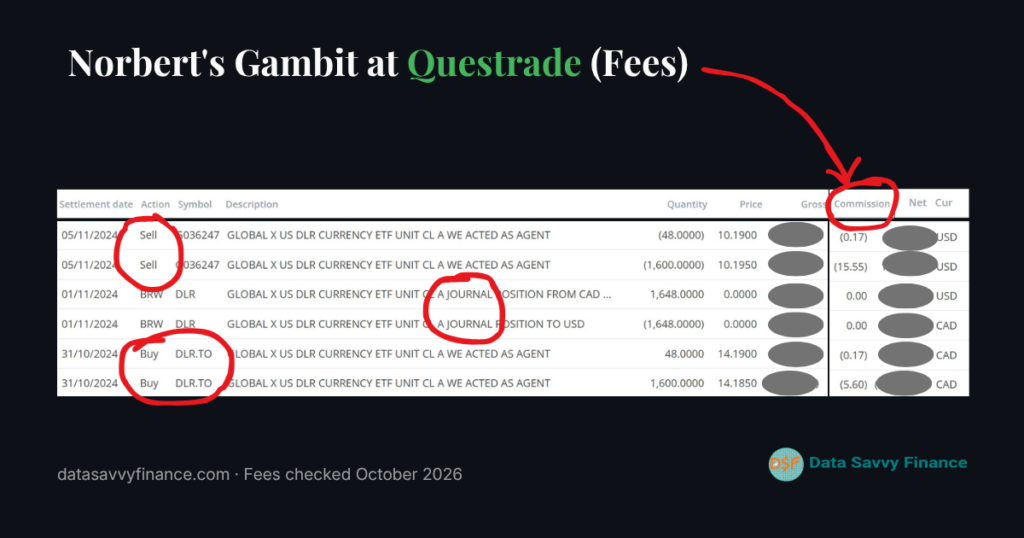
In my Questrade US-dollar RRSP, I converted $20,000 CAD this way in 2024 and ended up with about US$16,300, about a week from the first buy to the final sale. I bought the DLR in two orders, 48 shares and 1,600 shares, and those buys carried ECN fees of about $5.77 CAD. An ECN fee is a small exchange charge for removing liquidity, which happens when your order fills straight away against an order already waiting in the market. Mine were $0.0035 a share.
The sale of DLR.U cost US$15.72 across two lines. That matches Questrade’s 2024 pricing: a selling commission of a cent a share, capped at $9.95, plus ECN fees ($9.95 + $5.60 on the 1,600 shares, and $0.17 on the 48). I couldn’t find a separate journal fee in my records. All in, that’s about $25 CAD at the rate I got, against about $300 at a 1.5% conversion fee. Those figures leave out the bid-ask spread, which doesn’t show up as a line in my records.
Under today’s pricing, the same conversion would look different. Questrade has charged $0 commissions since February 9, 2025, and says ECN fees no longer apply to most stock and ETF trades ($0 commissions FAQ). The journal step now has its own $9.95 fee instead, so the visible cost would be about $10 plus the spread.
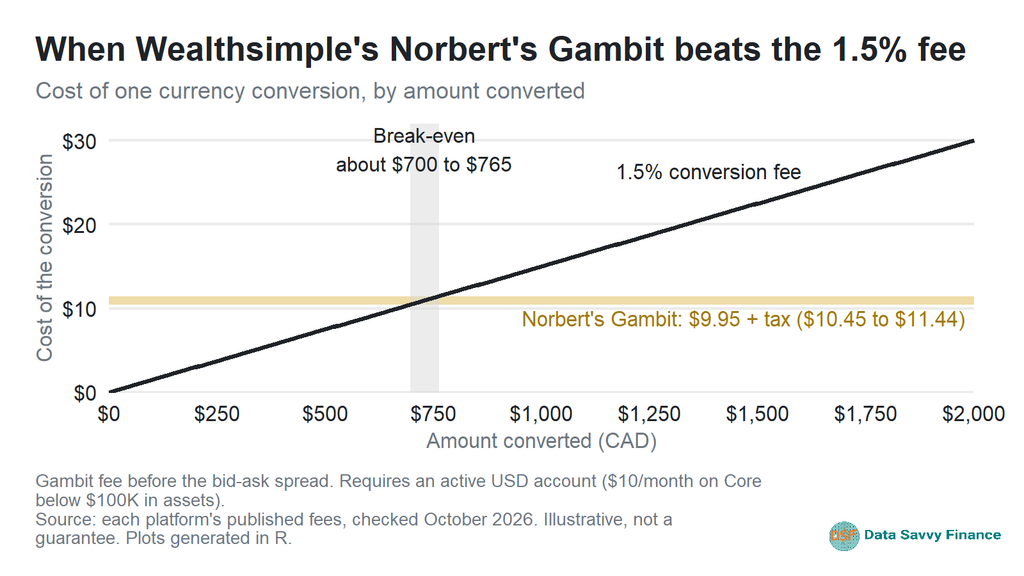
Wealthsimple now offers Norbert’s Gambit too, as a journal request for $9.95 plus tax (Wealthsimple Help Centre). Two catches: it works on the web only, not in the app, and you need an active USD account to use it. On the Core plan, that USD account is the $10 a month above, so the gambit adds up to $120 a year plus $9.95 per conversion until you reach $100,000 in assets.
The break-even is easy to run yourself. With sales tax, $9.95 comes to roughly $10.45 to $11.44 depending on your province (5% GST up to 15% HST). Divide that by 1.5%, and the gambit beats the standard conversion fee once you convert more than about $700 to $765 at a time. Below that, the percentage fee is cheaper. The same logic applies at Questrade, where a $9.95 journal fee breaks even at about $665.
Dividends, withholding and the W-8BEN
| Account | US withholding on US dividends | What it means |
| RRSP, RRIF, LIRA, LIF | Generally 0% on US stocks and US-listed ETFs held directly | The main reason to hold US dollars in a retirement account |
| TFSA, FHSA, RESP | 15%, not recoverable | Same at both platforms |
| Non-registered | 15% | Same at both platforms |
| Any account, Canadian-listed ETF holding US stocks | 15% at the fund level, not recoverable | Even inside an RRSP |
Source: Wealthsimple Help Centre, non-resident withholding taxes, checked October 11, 2026. The tax rules are the same at both platforms. Verified.
To get the 15% treaty rate instead of 30%, you’re asked to sign a W-8BEN, a short US tax form, usually when you open the account. Wealthsimple’s help article says the form is valid for three years and that it prompts you to renew it (Wealthsimple Help Centre).
Fractional US shares and automation
Both platforms offer fractional shares of eligible US stocks and ETFs, commission-free (Questrade, Wealthsimple). This is the one place Questrade’s automation catches up: its recurring buys cover eligible US-listed fractional securities, so a scheduled US-listed ETF purchase can run automatically at either platform (Questrade disclosure).
In numbers: if you buy US-listed securities with under $100,000 at Wealthsimple, Questrade saves you the $120 a year USD account fee. If you convert large amounts a few times a year, Norbert’s Gambit costs about the same at both, roughly $10 to $11 plus the spread, but at Wealthsimple it requires that USD account. If you sell US holdings and want Canadian dollars back, budget another 1.5% unless you use the gambit in reverse.
Questwealth vs Wealthsimple managed portfolios: what you pay
WordPress: set this heading’s HTML anchor to “managed”.
Both companies also offer a done-for-you option. You deposit money, and they choose, buy and rebalance a portfolio of ETFs for you. Questrade’s version is Questwealth Portfolios. Wealthsimple’s is managed investing. Both can be held in a TFSA. I haven’t used either, so everything in this section is Verified from their published pages.
You pay two layers of fees for this: a management fee to the platform, and the MER of the ETFs inside the portfolio. Here’s the management fee layer:
| Questwealth Portfolios | Wealthsimple managed investing | |
| Management fee | 0.25% ($250 to $99,999), 0.20% ($100,000+) (Questwealth fees) | 0.5% Core, 0.4% Premium ($100K+ total assets), 0.2% to 0.4% Generation ($500K+) (pricing) |
| Smallest balance shown | $250 | $1 |
| ETF MERs inside | 0.09% to 0.12% (SRI portfolios 0.20% to 0.24%) (Questwealth fees) | Not listed on the pages checked |
| TFSA available | Yes | Yes |
In dollars, the management fee alone works out to:
| Portfolio size | Questwealth | Wealthsimple |
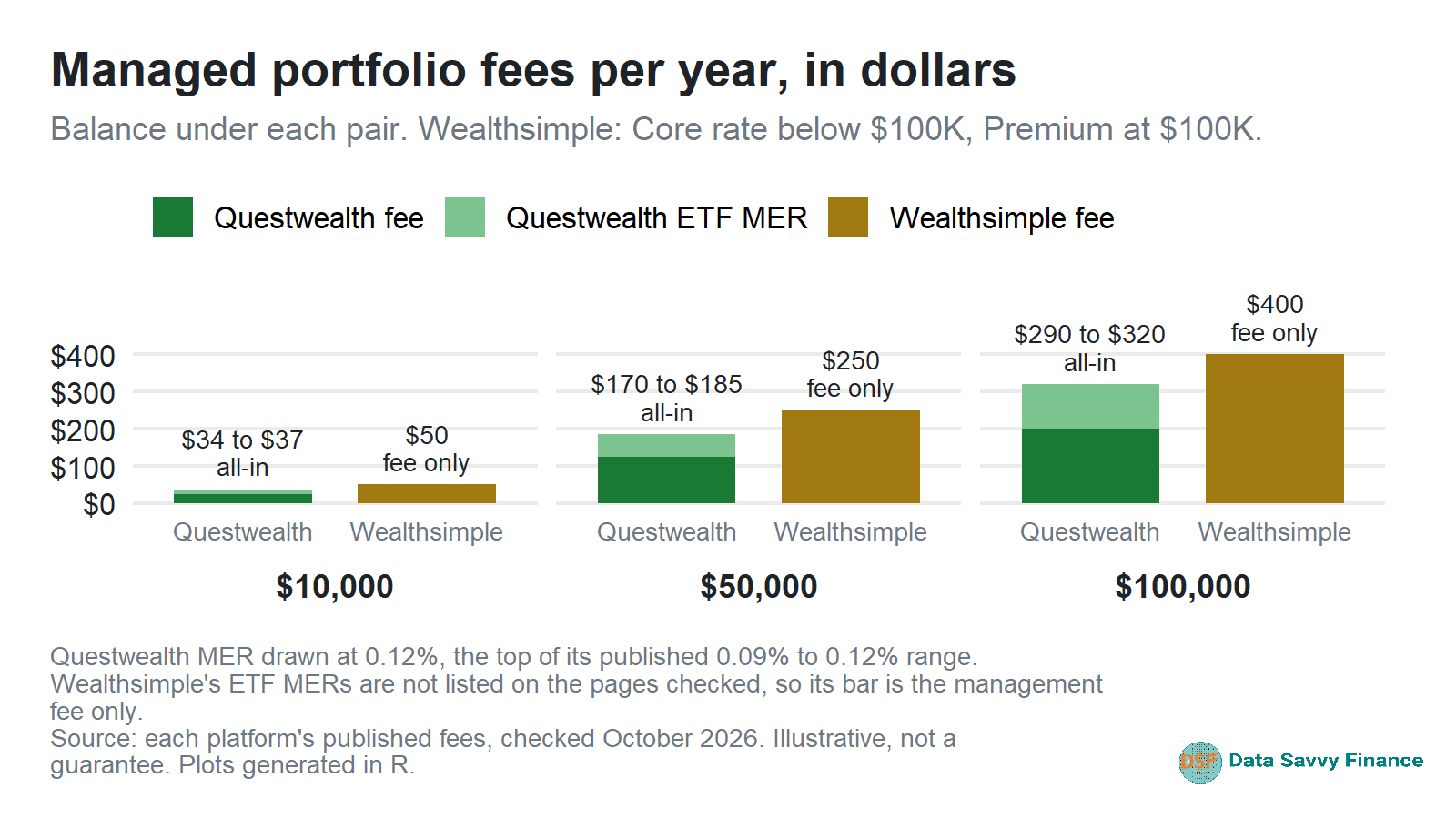
| $10,000 | $25/year | $50/year |
| $50,000 | $125/year | $250/year |
| $100,000 | $200/year | $400/year (Premium rate) |
My calculation: balance × the published fee rate. It assumes the rate applies to the whole balance and doesn’t include the ETF MERs inside each portfolio. Illustrative, not a guarantee.
Questrade does publish the second layer. Adding Questwealth’s 0.09% to 0.12% portfolio MER to its 0.25% fee puts the all-in cost on $50,000 at about $170 to $185 a year ($125 + $45 to $60). Wealthsimple’s pages I checked don’t list the MERs inside its managed portfolios, so I can’t give you the same all-in figure for it. Ask before you compare, because the management fee alone understates what you pay at both.
Two things to know:
- Wealthsimple’s rate depends on everything you hold with it, not just this one account. Your status is based on your total Wealthsimple assets or net deposits, whichever is higher. Someone with $60K managed and $40K in a self-directed TFSA would qualify for Premium (0.4%) (pricing).
- A managed portfolio still costs more than holding ETFs yourself. On $50,000, a self-directed TFSA with an all-in-one ETF costs only the ETF’s MER. The managed version adds $125 to $250 a year on top. Whether that’s worth it depends on how much you value never having to rebalance or second-guess yourself. Fees compound just like returns do, and a 1% MER can cost a $100,000 portfolio $25,038 over time.
Feature checklist: Questrade vs Wealthsimple (self-directed)
| Feature | Questrade | Wealthsimple |
| Fractional shares | Yes, eligible Canadian and US stocks and ETFs, $0 commission (source). Verified | Yes, thousands of Canadian and US stocks and ETFs, from $1, $0 commission (source). Used it |
| Recurring (automatic) investments | Yes, for eligible US-listed fractional stocks and ETFs only, $1 to $50,000 per order, not in margin or Questwealth accounts (source). Verified. Deposits can be automated. I place Canadian ETF buys myself. Used it | Yes, stocks, ETFs and crypto, in almost any trading account (source). Used it |
| Dividend reinvestment (DRIP) | Yes, free, set per account (source). Used it | Yes (source). Used it |
| Limit orders | Yes. Used it | Yes, and the order screen shows the bid and ask. Checked in the app, October 2026 |
| Holding US dollars | Separate US-dollar side in every account, no fee. Used it | USD account, $10/month on Core after a trial, free at $100K+ (source). Verified |
| Norbert’s Gambit | Supported, with a $9.95 journalling fee (fee schedule). Used it and Verified | $9.95 plus tax per request, web only, USD account required (source). Verified |
| Options | US options as low as $0/contract (source). Verified | $0 contract fee, but other fees apply (source). Verified |
| Bonds, GICs, international stocks, precious metals | Available, though commissions or fees may apply (source). Verified | Not listed on the pages checked |
| Managed portfolio option | Questwealth Portfolios. Verified | Managed investing. Verified |
Checked October 9 and 11, 2026. Features change, so confirm in each app.
What this means for a TFSA investor: if your plan is “buy one or two Canadian ETFs every payday,” the recurring-investment row matters most. In my own accounts, it’s the difference I notice most. At Wealthsimple, my contributions arrive and get invested automatically, fractional shares included. At Questrade, the deposits are automated, but I place each Canadian ETF buy myself, because its recurring buys currently cover US-listed securities only. Both platforms reinvest my dividends.
Pros and cons
Here’s where each platform helps and where it costs you, from my accounts and their published pages.
Questrade
Pros
- US dollars cost nothing to hold. Every account has a US-dollar side, so you convert once and keep the USD for later trades and dividends, without a monthly fee at any balance.
- Norbert’s Gambit works well at size. Funding my US-dollar RRSP in 2024, a $20,000 conversion took about a week and cost about $25 CAD in fees, against roughly $300 at a 1.5% fee. Under today’s $0 commissions, the visible cost is closer to the $9.95 journal fee.
- Questwealth is the cheaper managed option: 0.25% below $100,000 and 0.20% above, with portfolio MERs of 0.09% to 0.12% published alongside.
- A wider product shelf if you ever want it: bonds, GICs, international stocks and $0 US equity options, plus spousal, locked-in, corporate and trust accounts.
Cons
- Canadian ETF buys can’t be automated. Deposits can be, but its recurring buys cover US-listed fractional securities only, so every Canadian ETF purchase is placed by hand.
- Leaving costs $150 per transfer out, and coming in is uncertain: Questrade reimbursed $52.50 of my $146 transfer fee, and its page promises no fixed amount.
- The platform is busy. Buying an ETF is simple once you know where things are, but the screens are built for active traders first.
Questrade tends to suit investors who hold US-listed ETFs, convert currency in larger amounts or want the lower managed fee, and are happy placing their own buys. It’s less of a fit if you want every contribution invested automatically or think you may move your account later.
Wealthsimple
Pros
- Contributions can invest themselves. Recurring buys work for Canadian and US ETFs, fractional shares start at $1, and in my RRSP every deposit goes in without me placing a trade.
- Leaving costs nothing: $0 to transfer out or close. Coming in, its rule is clear, with one transfer-out fee reimbursed per $25,000 moved, up to $150 per account, if the money stays 90 days.
- A simple app that doesn’t hide the tools: limit orders are there, and the order screen shows the bid and ask before you submit.
- Every common registered account, including RRIF and LIRA, is available self-directed or managed.
Cons
- US dollars cost $10 a month plus tax on Core until your Wealthsimple assets reach $100,000, and its RRIF can’t hold US dollars at all.
- Its Norbert’s Gambit runs on the web only and needs that paid USD account, so on Core it adds up to $120 a year before the $9.95 per conversion.
- Managed investing costs twice Questwealth’s fee below $100,000 (0.5% vs 0.25%), and the ETF MERs inside aren’t listed on the pages I checked.
Wealthsimple tends to suit investors who buy Canadian-listed ETFs on a schedule and want each contribution invested automatically. It’s less of a fit if you hold US dollars with under $100,000 in assets there, or want the cheapest managed option.
Questrade vs Wealthsimple for beginners
If this is your first investing account, the costs are the same at both: $0 to open, no minimum, $0 to buy or sell an ETF. A common first setup is a TFSA or FHSA, a small monthly contribution and one Canadian-listed all-in-one ETF, which needs no US dollars at all (what all-in-one ETFs look like). So the differences that matter at the start are about effort, not money.
- Small amounts. At Wealthsimple, fractional shares start at $1, so a $50 contribution buys $50 of an ETF. Questrade also offers fractional shares on eligible securities, but you place each Canadian ETF buy yourself.
- Automation. At Wealthsimple, each contribution can be invested automatically. At Questrade, the deposit can be automatic and the buy is manual, so it’s one more thing to remember each month.
- The app. Wealthsimple is built around a short search, amount and buy. Questrade shows more data and more screens, which is useful later and a bit much on day one.
- The extras. Both apps put options and other trading tools a tap away, and Wealthsimple’s also offers crypto, futures and gold (pricing). None of them are needed for a buy-and-hold ETF account, and it helps to decide that before you open the app.
If you’d rather not pick an ETF at all, both offer a managed option: Questwealth from $250, Wealthsimple managed investing from $1, for an annual fee covered in the managed portfolios section. The 3-ETF portfolio example shows what a simple all-Canadian-listed setup can look like, as an illustration rather than a recommendation.
Questrade vs Wealthsimple on Reddit: what people say, checked against the fees
WordPress: set this heading’s HTML anchor to “reddit”.
Reddit is where a lot of people go to settle this question, so I read through 13 threads comparing the two, posted between roughly 2024 and October 2026. I’m not quoting anyone or counting votes. Instead, here are the claims that came up again and again, each checked against the platforms’ own pages, because forum threads are a good place to find questions and a poor place to find current fees.
Threads read October 11, 2026. Claims are paraphrased and checked against official pages on the same date. Older threads predate some 2025 to 2026 pricing changes, which is part of the point.
| What people keep saying | What the official pages show (Oct 2026) | Verdict |
| “For most people they’re basically the same now.” | Both charge $0 to buy and sell Canadian and US-listed stocks and ETFs online (Questrade, Wealthsimple). | Holds up for anyone buying Canadian-listed ETFs |
| “Wealthsimple is better for automatic investing.” | Wealthsimple’s recurring buys cover Canadian and US stocks and ETFs. Questrade’s cover eligible US-listed fractional securities only (Questrade disclosure). | Holds up, and matches my own accounts |
| “Questrade holds US dollars for free, Wealthsimple charges.” | Questrade accounts hold USD at no extra cost. Wealthsimple’s USD account is $10 a month plus tax on Core, included at $100,000+ (pricing). | Holds up |
| “Questrade’s conversion fee is 1.99%.” | Questrade’s fee page lists 1.5% (fees). | Out of date |
| “Wealthsimple will offer Norbert’s Gambit soon.” | It’s live: $9.95 plus tax per request, web only, and it needs an active USD account (help). | Out of date, with a catch the old threads couldn’t know |
| “Questrade started charging for Norbert’s Gambit.” | Its fee schedule lists $9.95 for journalling shares (fees). That arrived alongside $0 commissions, which removed the two selling commissions the gambit used to cost. | True, but incomplete: the total cost fell for most people |
| “Questrade has no Canadian fractional shares.” | Questrade’s fractional shares page now lists eligible Canadian and US stocks and ETFs (fractional shares). Automatic recurring buys still cover US-listed only. | Partly out of date: check your ETF is eligible |
| “Only Questrade offers a self-directed RESP.” | Wealthsimple’s account table lists RESP as both managed and self-directed (account table). | Out of date |
| “Wealthsimple refunds the fee when you transfer in.” | Its policy reimburses one transfer-out fee per $25,000 moved in, if the money stays 90 days (policy). | Holds up, with conditions |
| “Wealthsimple’s 1.5% sits on top of a rate that’s already worse than the market rate.” | Neither platform publishes its exchange-rate spread on the pages I checked, so I can’t confirm or rule this out for either one. | Not verified |
| “Customer service is poor at both.” | Wealthsimple lists 24/7 chat on every tier and priority phone support from Premium ($100,000+) up (pricing). I haven’t compared service quality, and anecdotes in these threads cut both ways. | Not verified |
What the threads get right
The most consistent point across every thread is the one this article lands on too: the platforms now cost the same to trade, and the real differences are currency and automation. People who buy Canadian-listed ETFs on a schedule tend to describe Wealthsimple as easier to live with. People who hold US stocks tend to stay at Questrade for the free US-dollar side. Several posters also point out that if you hold your ETFs in a TFSA, buying a Canadian-listed version of the same index avoids the conversion entirely, and in a TFSA the 15% US withholding tax applies either way, so you give up little by doing it.
What’s out of date
A lot of the strongest opinions were written before 2025. Questrade’s selling commission is gone, Wealthsimple’s Norbert’s Gambit has launched, Questrade now lists eligible Canadian fractional shares, and Wealthsimple now offers a self-directed RESP. If a thread is more than a year old, check its fee claims against the tables above before acting on them.
Promotions drive a lot of the switching
A surprising number of posters moved for a promotion, not a fee: a transfer match, a phone or a laptop. Wealthsimple’s current 1% match pays out over 24 monthly payments, requires registering before you transfer, needs at least $25,000, and reduces the payout if you withdraw more than 20% within the two-year holding period (match terms). Its terms also refer to a separate 3% match for active traders, whose conditions I didn’t verify. The point several commenters made is worth repeating: judge a promotion by its annual value over the lock-in, not the headline. A 1% match paid over two years works out to roughly 0.5% a year, before you count the $150 Questrade charges to transfer out.
The broker that keeps coming up but isn’t in this comparison
In almost every thread about US dollars, someone recommends Interactive Brokers for cheaper currency conversion. That claim falls outside this article, and I haven’t verified its fees, so I can’t tell you whether it holds for your amounts. It’s worth knowing the option exists if you convert large sums often.
Before you choose: questions at the decision point
These are the hesitations that tend to come up right before opening an account, answered as directly as the numbers allow.
I already have an account at one of them. Is it worth switching?
It depends on what you hold, because commissions are $0 at both, so there is nothing to save there. The savings that do exist are specific: about $120 a year if you hold US dollars at Wealthsimple Core below $100,000 in assets, $125 a year in management fees on a $50,000 managed portfolio, or the time saved if you want Canadian ETF buys automated. Weigh that against the cost of moving. Questrade charges $150 to transfer an account out, Wealthsimple charges $0, and fractional shares have to be sold before any transfer. You also don’t have to pick one. I hold accounts at both.
What if I choose one and want to leave later?
Leaving Wealthsimple costs $0 for an outgoing transfer and $0 to close the account. Leaving Questrade costs $150 per transfer out, full or partial. The receiving firm may reimburse that fee: Wealthsimple reimburses one transfer-out fee for every $25,000 you move in, if the money stays 90 days, and Questrade says it might reimburse with no amount stated. Ask before you start, not after.
Can I start with a small amount, like $50 a month?
Yes at both, with a difference in effort. Neither has a minimum for self-directed accounts. At Wealthsimple, fractional shares start at $1 and recurring buys invest each contribution automatically, so $50 buys $50 of an ETF. At Questrade, you can automate the $50 deposit, but you place the Canadian ETF buy yourself, and its automatic recurring buys cover US-listed fractional securities only. For managed portfolios, Questwealth starts at $250 and Wealthsimple at $1.
Do I even need US dollars?
Not necessarily. Many Canadian-listed ETFs hold US and global stocks while trading in Canadian dollars, and if that is all you buy, every currency difference in this article stops applying to you. US dollars matter if you want US-listed ETFs. In an RRSP, US-listed ETFs avoid the 15% US withholding tax on dividends, because the US tax treaty recognizes RRSPs, and that is the usual reason investors take on the conversion cost. In a TFSA, the 15% applies either way. Whether the saving outweighs the conversion depends on how much you hold and how often you convert.
What happens to my money if one of these firms fails?
Both are CIPF members. CIPF covers eligible assets up to $1 million per account category if a member firm becomes insolvent. Your TFSA, FHSA, cash and margin accounts share one $1 million general limit, and your RRSP, RRIF, LIRA and LIF share a separate $1 million retirement limit. CIPF covers the firm failing, not investments falling in value.
Should I use a managed portfolio instead of doing it myself?
It depends on what you would actually do on your own. In dollars, on $50,000: an all-in-one ETF held yourself costs roughly $100 to $125 a year in MER at 0.20% to 0.25% (what a good MER looks like). Questwealth costs about $170 to $185 all-in. Wealthsimple managed costs $250 in management fees, plus ETF MERs it doesn’t list on the pages I checked. The extra $45 to $150 or more buys automatic rebalancing and no decisions. If you would rebalance once a year and leave it alone, that is a cost. If you would otherwise hold cash or sell in a downturn, it may be worth paying for. Only you know which describes you.
What it comes down to
Both platforms now charge $0 to trade, so the question has shrunk to three differences. If you only buy Canadian-listed ETFs, the difference is effort: whether you want each contribution invested for you. If you hold US dollars, it’s $120 a year below $100,000 in Wealthsimple assets, plus how often you convert. And if you might move later, it’s $150 to leave Questrade and $0 to leave Wealthsimple. Everything else in this article is detail around those three.
That’s roughly how my own accounts ended up split: a US-dollar RRSP at Questrade, where holding USD costs nothing, and an all-Canadian RRSP at Wealthsimple that invests itself. Neither needed an advisor or a finance degree, just the fee pages and a little arithmetic. If you want to see what a fee gap adds up to over your own timeline, the investment growth calculator runs it with your numbers rather than mine.
If a fee here doesn’t match what you see in your own account, email support@datasavvyfinance.com. I check it against the official page and log the correction publicly.
Frequently Asked Questions
Yes. Both are regulated by CIRO (the Canadian Investment Regulatory Organization) and are members of the Canadian Investor Protection Fund (CIPF), which covers eligible client assets up to $1 million per account category if a member firm becomes insolvent.
No. Questrade charges $0 to buy and sell Canadian and US-listed stocks and ETFs online. Older articles may still list a $4.95 to $9.95 selling fee, which no longer applies. There are no annual account fees for self-directed accounts. Converting currency costs 1.5%.
Wealthsimple charges $0 to buy and sell stocks and ETFs, with no account fee. Without a USD account, US trades carry a 1.5% currency conversion fee. A USD account costs $10 a month on the Core plan after a 30-day trial and is free once your total Wealthsimple assets reach $100,000.
Self-directed investing (formerly Wealthsimple Trade) lets you choose and buy ETFs yourself, with no management fee. Managed investing (formerly Wealthsimple Invest) builds and rebalances a portfolio for you based on a risk questionnaire, for an annual management fee of 0.5% on Core, 0.4% on Premium and 0.2% to 0.4% on Generation, plus the MERs of the ETFs inside.
Yes, and I do. Your TFSA and RRSP contribution room is personal and isn’t affected by how many institutions you use. Neither platform sees contributions you make at the other, so track your room in CRA My Account. Spreading accounts across platforms adds some admin, which is worth weighing against any fee benefit.
No. A direct registered account transfer between institutions doesn’t count as a withdrawal, and your contribution room is preserved. Withdrawing the money yourself and re-depositing it does count as a withdrawal. Always use the formal transfer process through the receiving institution.
Norbert’s Gambit converts Canadian dollars to US dollars (or back) by buying a security that trades in both currencies and selling it in the other one, which avoids the usual 1.5% conversion fee. Questrade has supported it for years, and its fee schedule lists $9.95 for the journal step. Wealthsimple now offers it for $9.95 plus tax per request, on the web only, and you need an active USD account to use it.
Questrade’s automatic recurring buys cover US-listed fractional securities only, and it charges 1.5% to convert currency unless you use Norbert’s Gambit. Wealthsimple’s USD account costs $10 a month on Core until you reach $100,000 in assets, its Norbert’s Gambit works on the web only and needs that USD account, and its RRIF can’t hold US dollars. Both update features often, so check each pricing page before deciding.
Yes. Whole shares and ETFs can usually move “in kind” (without selling) by requesting the transfer from the receiving platform. Fractional shares can’t be transferred between brokerages and must be sold first. For a TFSA, always request a direct transfer so your contribution room isn’t affected. Questrade charges $150 to transfer an account out, and Wealthsimple charges $0.
You sell what you want to withdraw, wait for the trade to settle, then move the cash to your bank. Tax rules come from CRA, not the platform. Withdrawals are tax-free, and the amount is added back to your contribution room on January 1 of the following year, not right away. Re-depositing it in the same year can put you over your limit.
For most long-term investors, yes. A TFSA shelters growth, dividends and withdrawals from Canadian tax, and broad-market ETFs give you low-cost diversification. The main exception is US-listed ETFs that pay dividends: the 15% US withholding tax on those dividends can’t be recovered inside a TFSA. Some investors hold those in an RRSP instead and keep Canadian-listed ETFs in the TFSA. Which mix fits you depends on your timeline, your other accounts and your tax situation.
Related guides
If this comparison answered your platform question, these pick up the next one:
- How a Questrade TFSA works: room, fees and setup
- ETF fees vs mutual fund fees in Canada: a $186,174 difference
- What is a good MER for ETFs in Canada?
- The 3-ETF portfolio for Canadian investors (illustrative example)
- How I built a low-cost RRSP ETF portfolio (case study)
- Investment growth calculator: run your own fee scenarios
About the author
I’m Biljana Jonoska Stojkova, the founder of DataSavvy Finance. I have years of formal training in mathematics and statistics and work with data for a living, which mostly means I ask what a number is hiding before I trust it. I’m a self-directed investor with accounts at both Questrade and Wealthsimple, and I’m not a registered financial advisor. You can read how I research platform comparisons and more about DataSavvy Finance.
Educational Disclaimer
| Platform Content Disclaimer This article compares features of Questrade and Wealthsimple for educational purposes only and does not constitute investment advice or a platform endorsement. It describes differences in platform structure, fees and account types as of October 2026. These features change, so always verify current information on each platform’s official website. General Educational Disclaimer DataSavvyFinance.com provides educational information only and does not provide financial, investment, legal or tax advice. Content is not tailored to any individual’s financial situation. Investing involves risk, including the possible loss of principal. Past performance does not guarantee future results. This article does not recommend opening an account with any specific platform and does not imply that any platform is suitable for any particular investor. If you are unsure which platform or investment approach is appropriate for your situation, consider speaking with a registered financial advisor or investment professional. |